
Circular Knitting
20–23 kgper roll
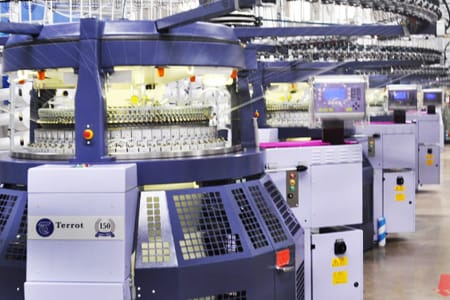
Knitting in tube form on circular machines; roughly 20–23 kg of greige fabric per roll.
On circular knitting machines the yarn is knitted in tube form, so the fabric comes off as a seamless cylinder. At this stage the greige fabric is still undyed and unfinished; the knit structure and its density are set here.
A roll’s actual weight depends on the fabric quality. Depending on the product quality, roughly 20–23 kg of tube fabric is produced per roll; each roll’s weight is recorded and carried forward with that record to the next steps.
The tube form makes it easier to feed the greige fabric cleanly into the dyehouse and finishing lines. Every roll produced is numbered, so it can be traced through to quality control and dispatch.
| Knit type | Circular (tube) knitting |
|---|---|
| Roll weight | Approx. 20–23 kg |
| Form | Fabric in tube form |
| Material | Greige fabric (undyed) |
Related guides: The Circular Knitting Machine: Single-Jersey vs Double-Jersey Architecture, OEMs and Production Ranges · Tubular or Open-Width? The Take-Down Route and Why It Matters · Knit Defects: Spirality, Barré and Holes — Root Cause and Control
Fabrics made in this unit
| Single Jersey | 80–350 g/m² |
|---|---|
| Piqué | 100–370 g/m² |
| Rib | 150–500 g/m² |
| Interlock | 80–400 g/m² |
| French Terry | 150–350 g/m² |
| Three-thread Fleece | 200–350 g/m² |
| Mesh & Net | 70–250 g/m² |
| Polar Fleece | 100–400 g/m² |
| Sport & Technical | 85–250 g/m² |
Questions about this unit
What is the difference between single-jersey and double-jersey machines?
Single-jersey machines use one needle cylinder; the face and the back of the fabric are visibly different. Single jersey, single-face net and piqué come from this family: they give lightness and stretch in both directions but the EDGE CURLS. A double-jersey machine adds a dial to the cylinder; interlock, rib, 8-lock and 3D spacer are born here: both faces smooth, no curling, twice the thickness and a dimensionally stable ground.
What sets the fabric weight on the machine?
In practice, loop length and yarn count. A common model expresses weight as GSM ≈ K / (Ne × loop length); however a constant such as K ≈ 12,069 is NOT AN ESTABLISHED STANDARD but a published model and should be treated as indicative. Typical ranges: diameter mostly 30–34 inches, gauge E18–E28. Positive yarn feed (Memminger-IRO/BTSR) delivers a constant yarn length to every loop, which is what makes the weight repeatable.
Why is fabric processed open-width (slit)?
Open-width slits the fabric at the edge and opens it flat, which allows disperse dyeing and stenter fixation without creasing or fold marks and clarifies the width. The tubular route instead offers a seamless edge and a particular hand.
From the guide: Tubular or Open-Width? The Take-Down Route and Why It Matters
Should I choose tubular or open-width?
Tubular for a seamless edge and a specific innerwear hand; open-width for crease-free even dyeing, stable width and most outerwear fabrics.
From the guide: Tubular or Open-Width? The Take-Down Route and Why It Matters