Certificates an independent eye
Quality certified by independent audit.
From management systems to product safety, recycled-content traceability to social compliance — we work with ten independent certificates. Review and download each one below.
Management Systems
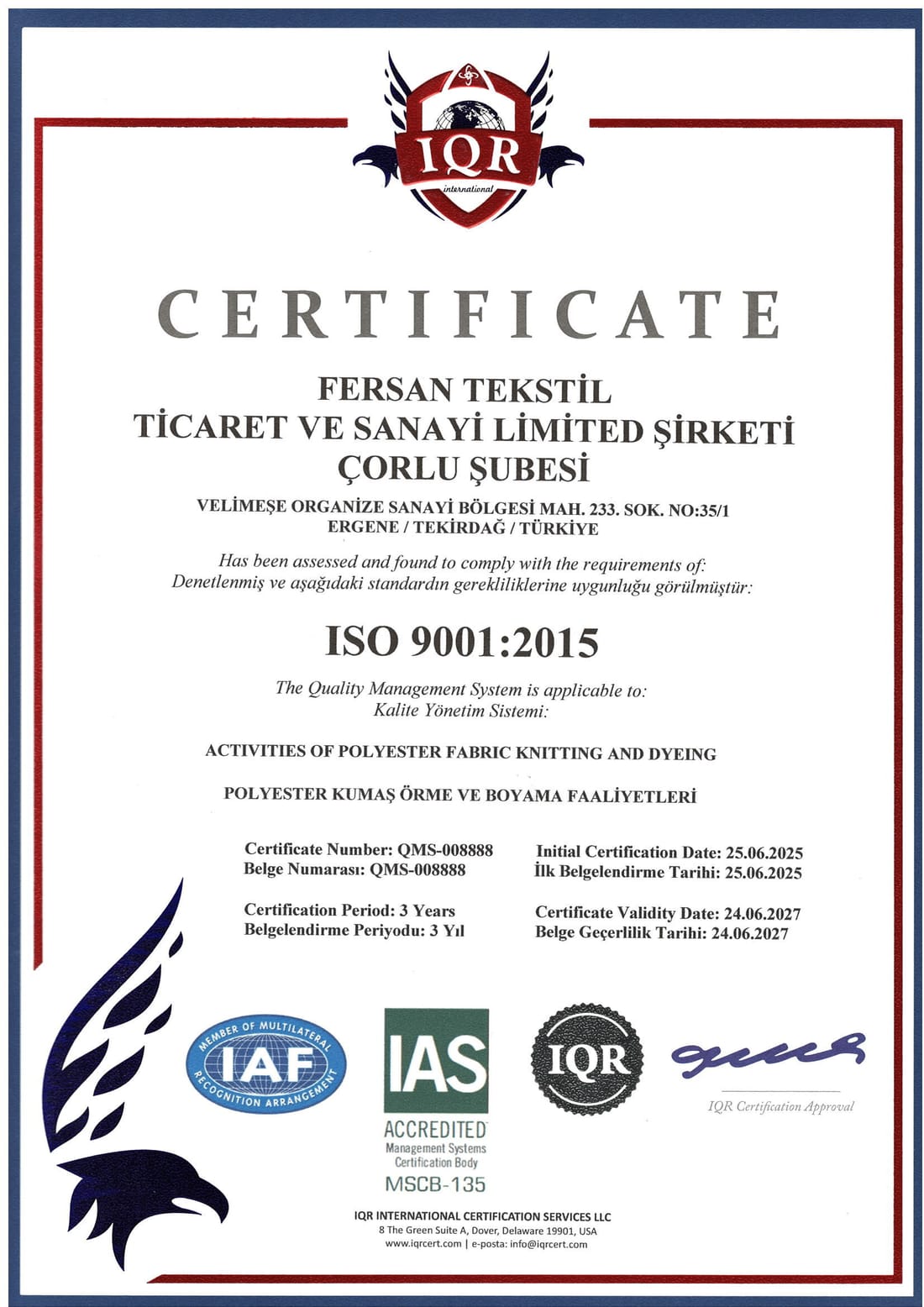
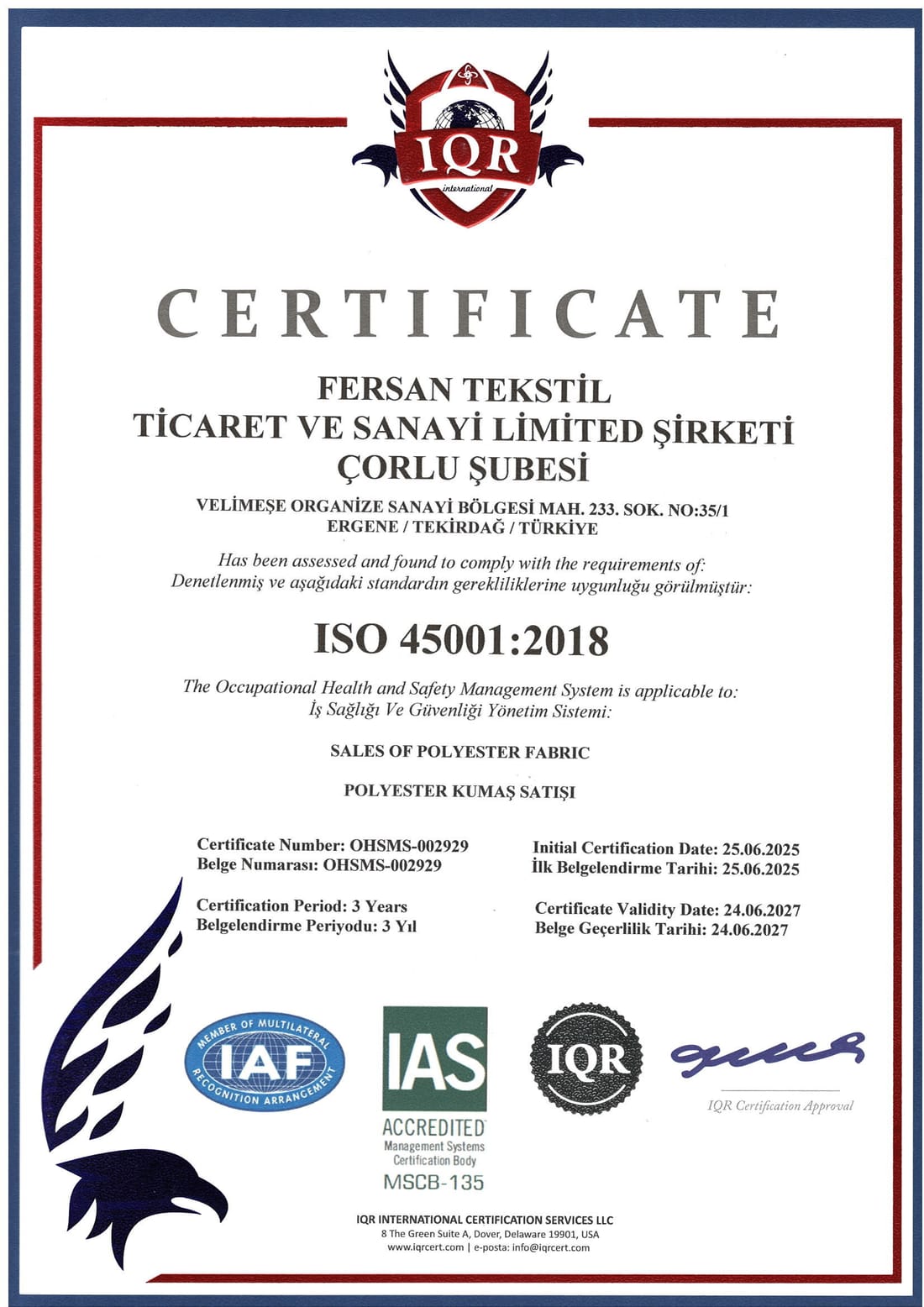
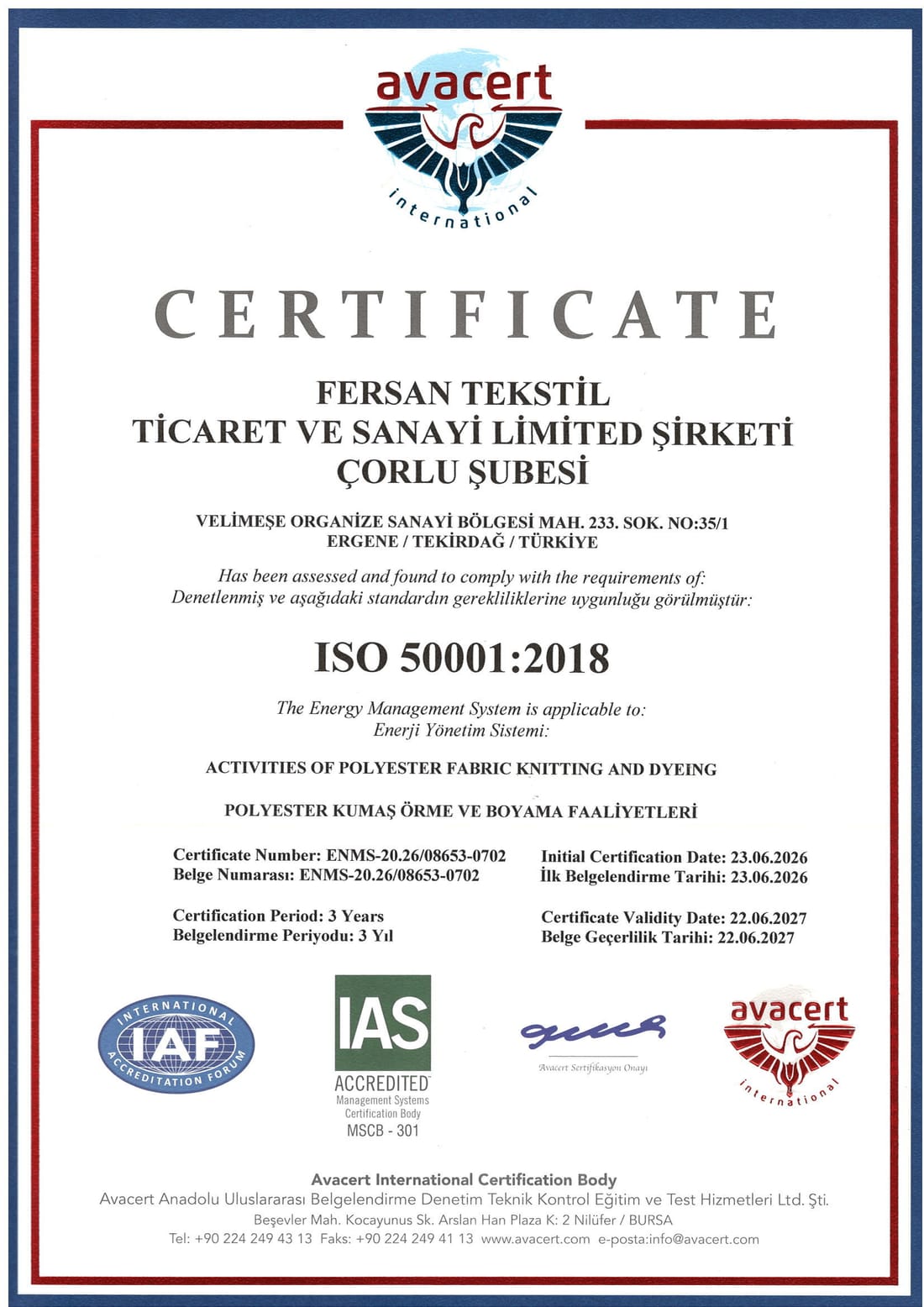
ISO 9001 · ISO 10002 · ISO 14001 · ISO 45001 · ISO 50001
Product Safety & Clean Production
STANDARD 100 · OEKO-TEX STeP
Recycled Content & Traceability
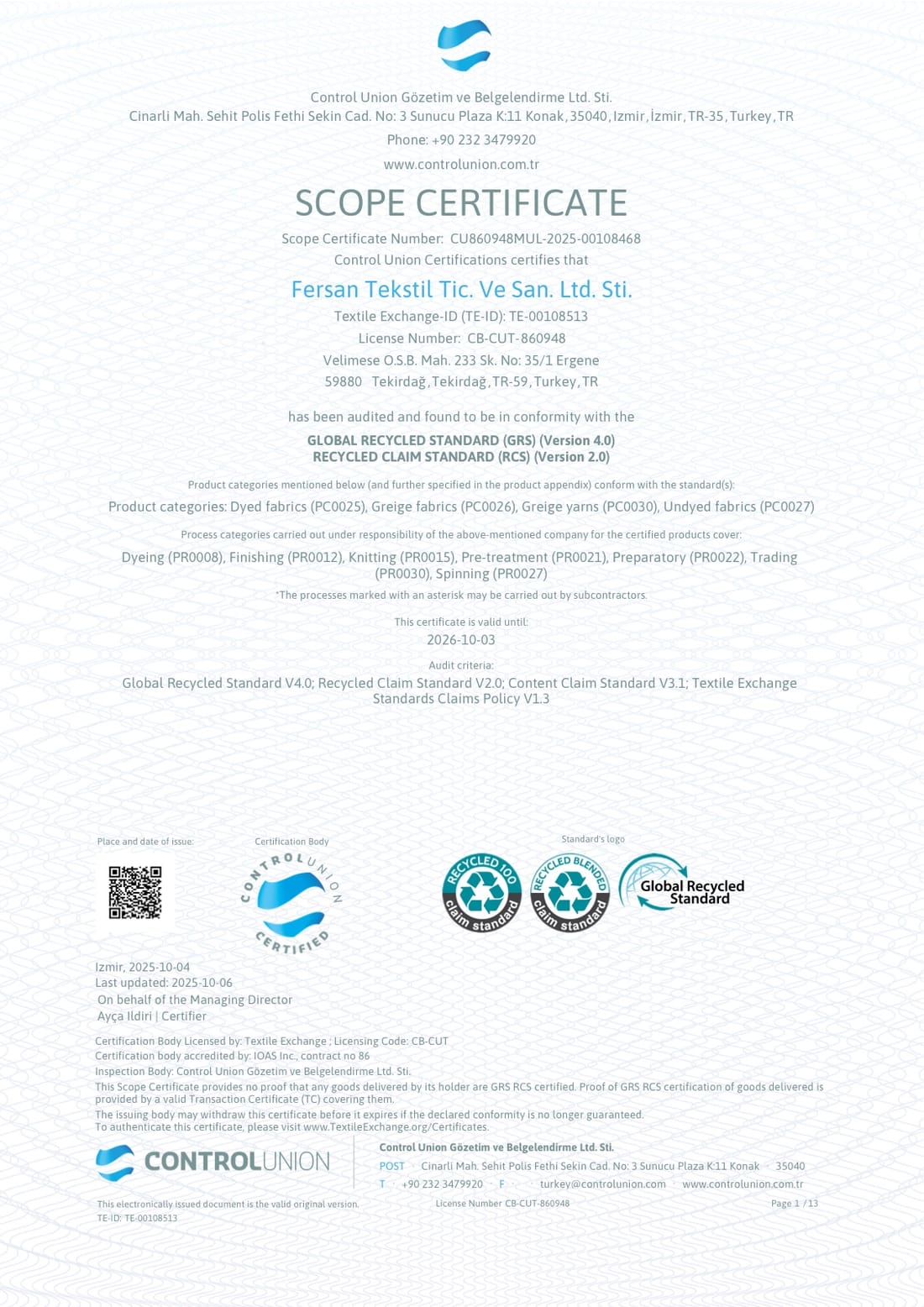
GRS · RCS
Social & Environmental Performance
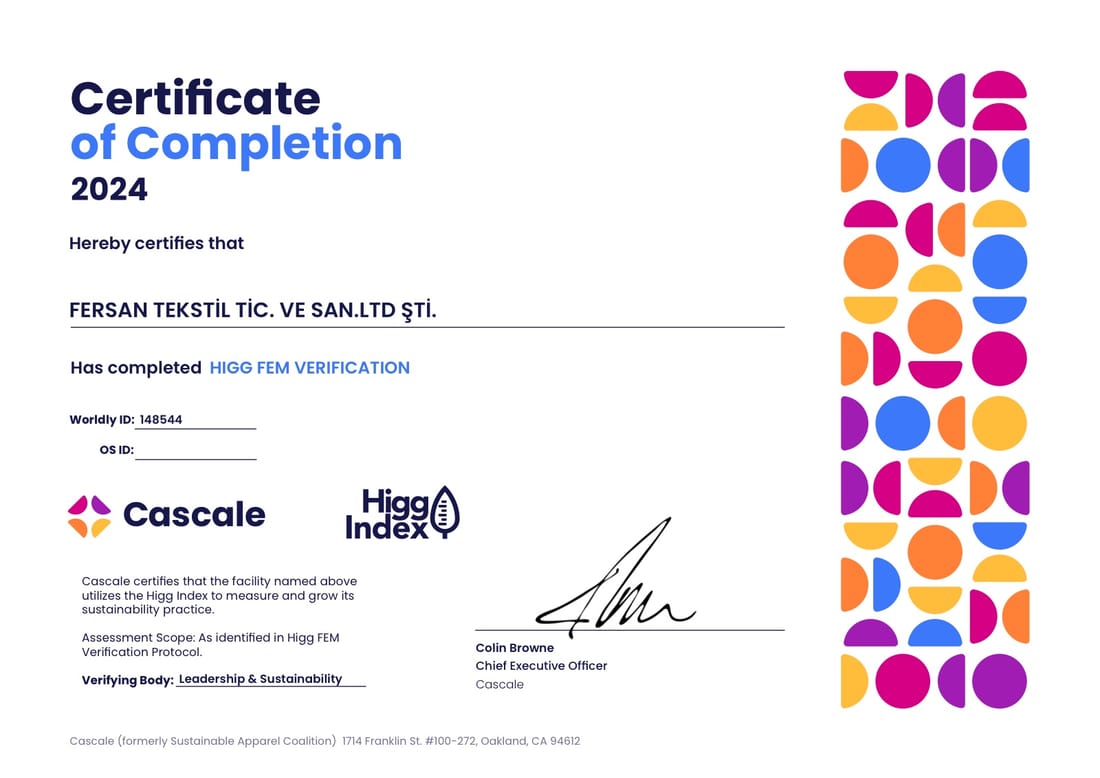
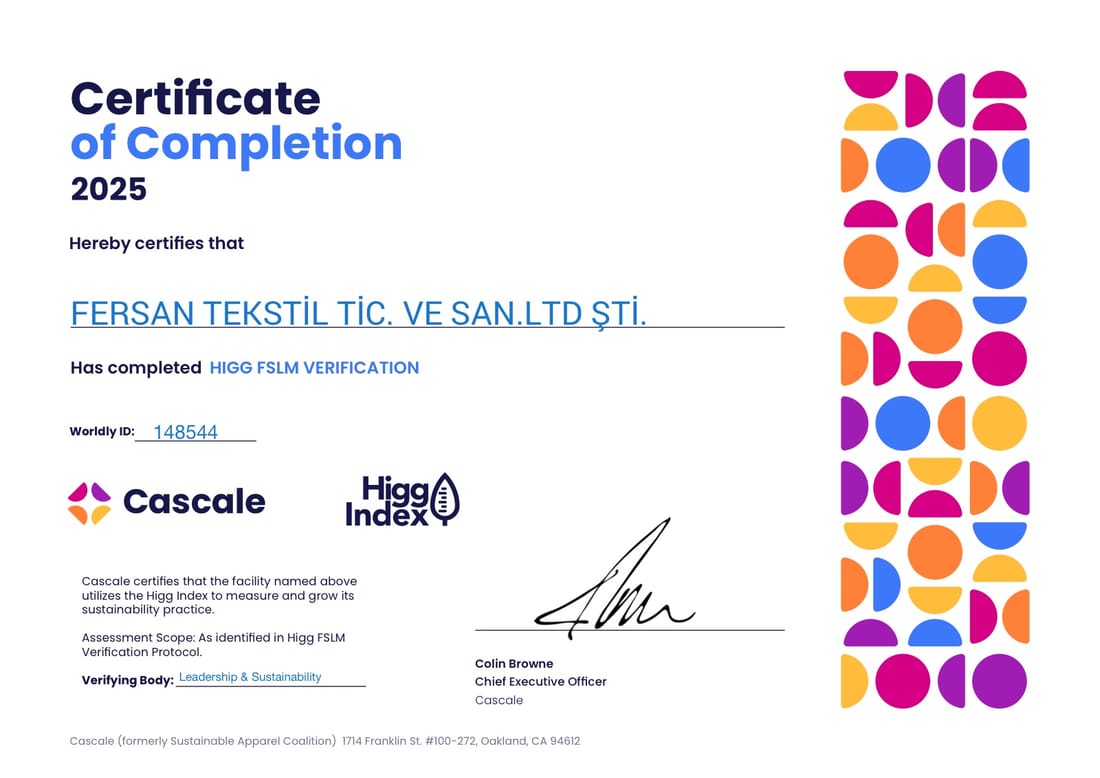
Higg FEM · Higg FSLMindependently verified assessment
10 independent documents · downloadable
independent documents · downloadable
05 independent audit bodies
independent audit bodies
STeP · LEVEL 2 / 3
OEKO-TEX STeP result
Certificates
Documents
Our management systems, product safety and sustainability are documented by independent audit. Certificates are grouped by category; each card links to a detail page and a downloadable file.
Management Systems
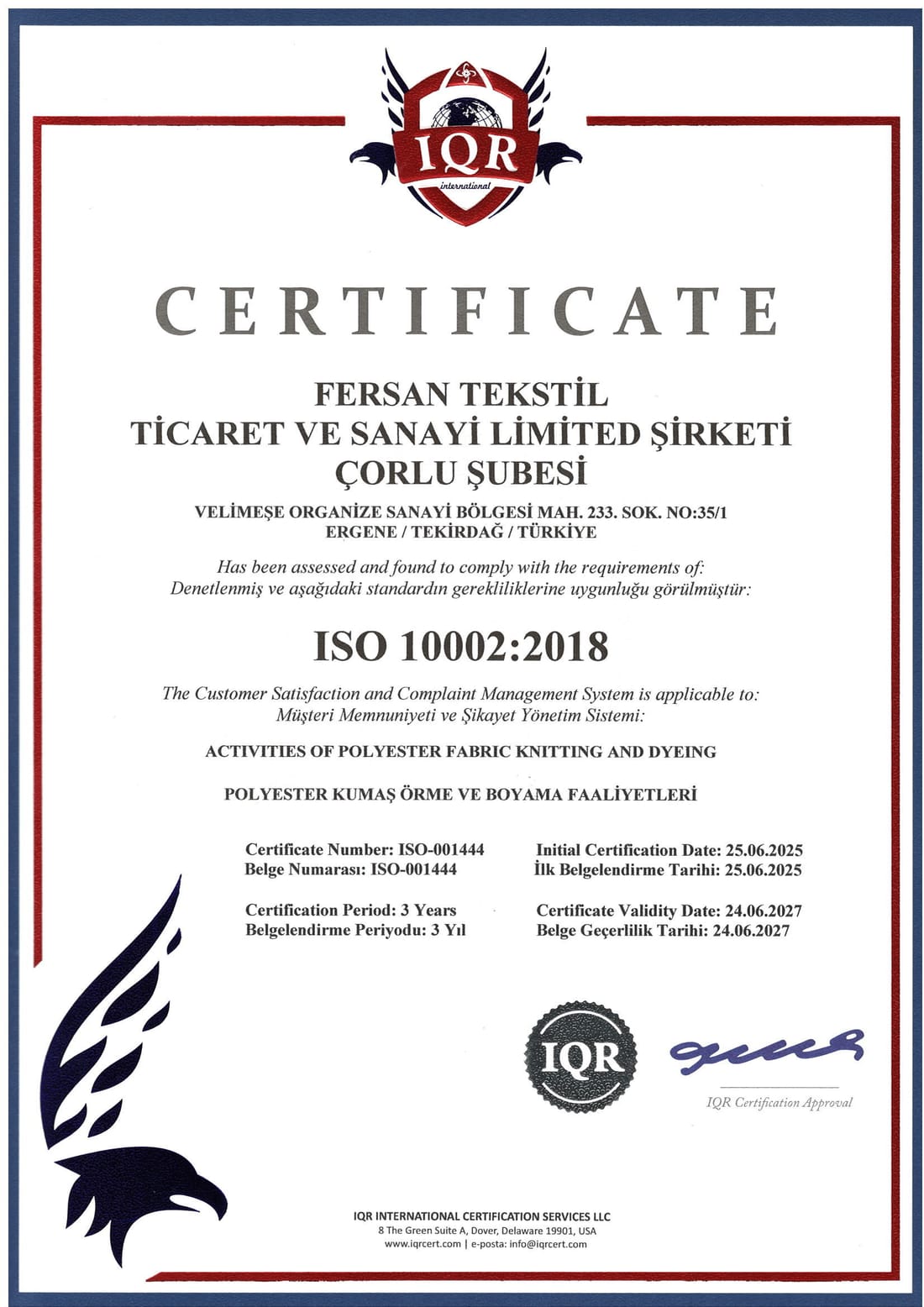
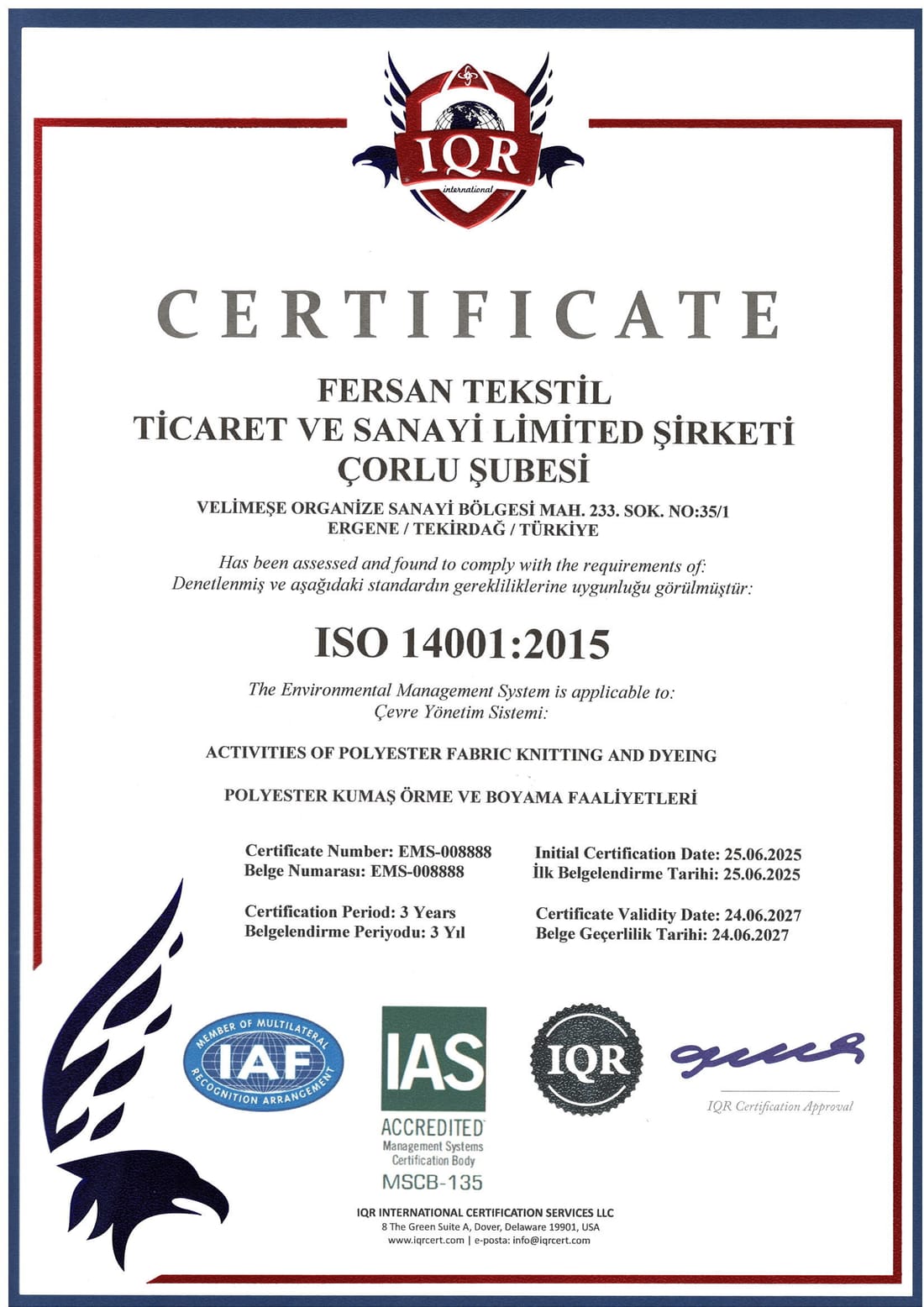
The ISO systems that govern quality, environment, energy, occupational safety and customer satisfaction — certified by IQR International (IAS · MSCB-135) and Avacert International (IAS · MSCB-301).
Product Safety & Clean Production
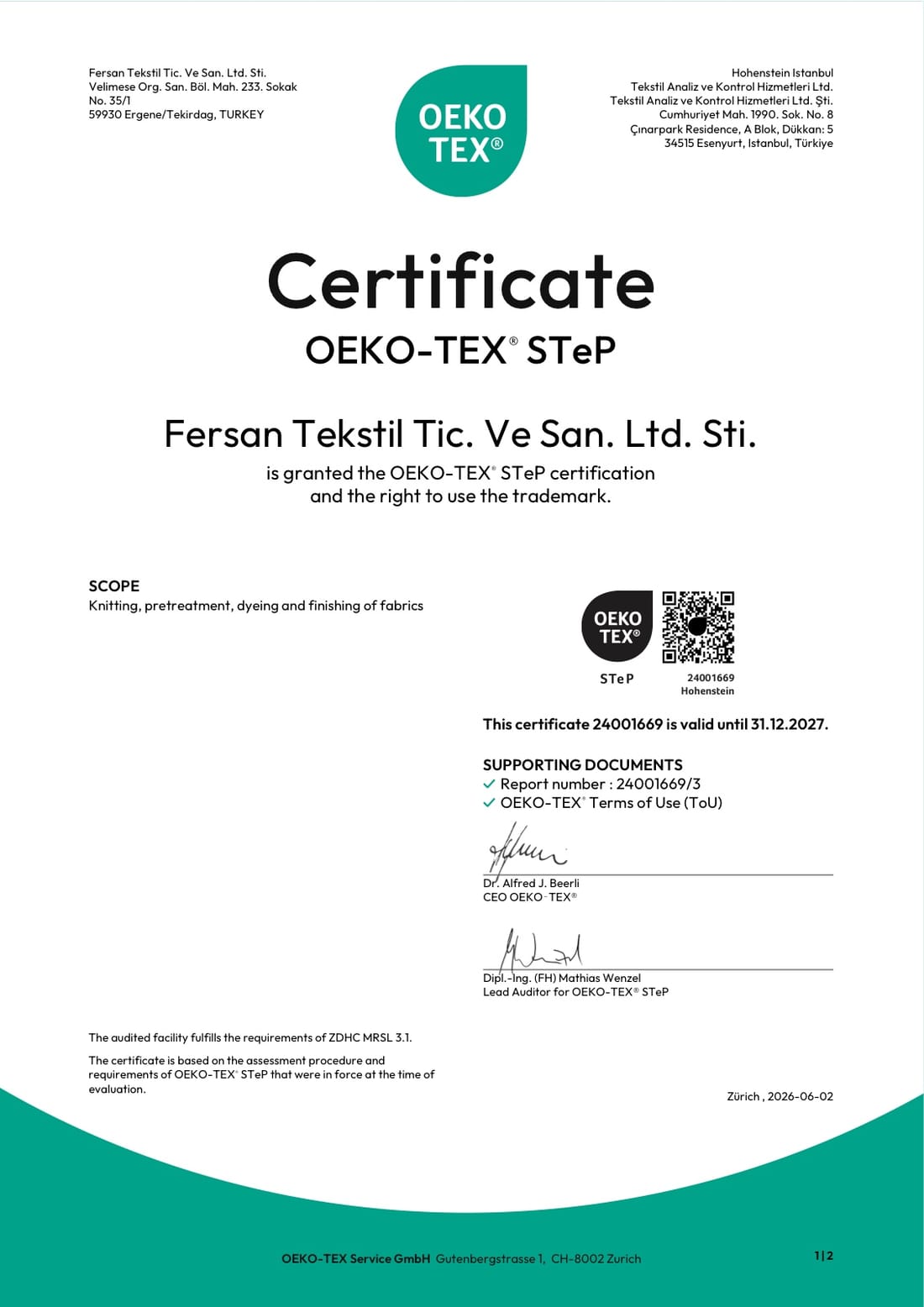
OEKO-TEX credentials confirming the fabric is free of harmful substances and that production runs on clean chemical discipline.
Recycled Content & Traceability
Independent chain-of-custody proof for recycled-polyester (rPET) claims — Textile Exchange standards, audited by Control Union.
Social & Environmental Performance
Higg/Cascale modules where the facility’s environmental and social-labor performance is measured on a common scale and independently verified.
Our certificates are issued under independent audit; current copies are shared on request.
Certificates
What each certificate proves — and what it does not
Two of the ten are product credentials: they speak about the fabric itself. The other eight are facility credentials, documenting the site and the system behind production; each one's own scope is stated in its row. The right-hand column names the certificate that answers what a given one cannot.
| Certificate | Layer | What it proves | What it does not prove |
|---|---|---|---|
| ISO 9001 | Facility credential | That knitting and dyeing run under an audited quality system managing the drift between approved sample and bulk. | It does not prove any single roll meets your spec, nor the fabric’s chemical safety — OEKO-TEX STANDARD 100 covers that. |
| ISO 10002 | Facility credential | That a defined system for recording, tracking and turning complaints into preventive improvement is certified; the scope is knitting and dyeing. | It proves how a complaint is handled, not product quality: ISO 9001 covers the production system, OEKO-TEX STANDARD 100 the fabric. |
| ISO 14001 | Facility credential | That water, energy, chemicals, waste and emissions are managed through an audited environmental system covering knitting and dyeing. | It does not prove energy use is tracked through a measured system — ISO 50001 does; independent assessment of chemical management sits in OEKO-TEX STeP. |
| ISO 45001 | Facility credential | That occupational health and safety is handled through a management system; the certificate’s scope is the sales of polyester fabric only. | It does not cover the knitting and dyeing floor — scope is sales only. Verified Higg FSLM and OEKO-TEX STeP cover conditions on that floor. |
| ISO 50001 | Facility credential | That energy use is tracked through a measured system — energy baseline and performance indicators; the scope is knitting and dyeing. | It does not prove a carbon-footprint figure; the facility’s measured GHG and energy data sit in the verified Higg FEM module, shared through Worldly. |
| STANDARD 100 | Product credential | That certified fabric was lab-tested against the limit-value catalogue for substances harmful to health — Hohenstein, three test numbers. | It says nothing about the environmental or social conditions of production — OEKO-TEX STeP and Higg FEM/FSLM do; recycled content is GRS/RCS. |
| OEKO-TEX STeP | Facility credential | A six-module facility assessment of knitting, pretreatment, dyeing and finishing — ZDHC MRSL 3.1 met, overall result Level 2. | It does not prove harmful-substance testing of individual fabrics — OEKO-TEX STANDARD 100 does; recycled content is the GRS/RCS Scope Certificate. |
| GRS · RCS | Product credential | Which fabric and yarn compositions carry certified recycled content and at which label grade — two sites, audited by Control Union. | It does not prove a specific shipment is certified — a per-shipment Transaction Certificate does; the Scope Certificate establishes the facility’s entitlement. |
| Higg FEM | Facility credential | That the facility’s water, energy, GHG, waste, chemistry and wastewater data are measured and, for 2024, independently verified. | It does not prove working conditions or worker rights — Higg FSLM does; product testing sits in OEKO-TEX STANDARD 100. The 2025 FEM is self-assessment only. |
| Higg FSLM | Facility credential | That working conditions, wages, hours, safety and worker rights were assessed and, for the 2025 period, independently verified. | It does not prove environmental performance — Higg FEM covers that; the 2026 file we hold is a self-assessment, the last independently verified period is 2025. |
Frequently asked questions.
Verification & validity
How can I verify independently that your certificates are genuine and still valid, without asking you?
Every certificate number and issuing body is printed both on the certificate wall and on that certificate’s own page; where the scheme has an online verification portal, the link sits next to the document. The OEKO-TEX numbers (13.HTR.34221 · 21.HTR.93044 · 23.HTR.99329) can be checked on OEKO-TEX Label Check and the GRS/RCS scope certificate (CU860948MUL-2025-00108468) in Textile Exchange’s Find Certified Company directory; the Higg modules can be looked up on the Worldly platform by facility ID (Worldly ID 148544) if you have platform access. For the ISO certificates you can query the issuing body directly with the number — IQR International for QMS-008888, Avacert International for ENMS-20.26/08653-0702.
Which body issued your certificates, and is it accredited — what is the accreditation number?
ISO 9001, ISO 14001 and ISO 45001 were issued by IQR International under IAS accreditation MSCB-135. ISO 10002 also comes from IQR International, but that certificate carries no accreditation mark, and we leave that field empty exactly as the document does. ISO 50001 was issued by Avacert International under IAS · MSCB-301. GRS/RCS was audited by Control Union (IOAS · TE-00108513); the OEKO-TEX credentials come from Hohenstein and the Higg modules from Cascale/Worldly.
The OEKO-TEX file you sent has no expiry date or scope — is that the certificate itself, or just a label image?
You read it correctly: the three files are not the certificate itself but the OEKO-TEX label button. Each carries only the OEKO-TEX logo, the words STANDARD 100, the test number (13.HTR.34221 · 21.HTR.93044 · 23.HTR.99329), the name of the issuing institute (Hohenstein), a verification QR code and the address www.oeko-tex.com — no expiry date, product class or scope appears on the label button. Query the number on OEKO-TEX Label Check to see the current status; the full certificate is shared on request.
Your certificate says the certification period is 3 years, yet validity reads 25.06.2025–24.06.2027; which one is binding?
Both are correct and they do not conflict. “Certification Period: 3 Years”, printed on all five of our ISO certificates, defines the length of the certification cycle: within that cycle, annual surveillance audits follow the initial certification, the certificate is reissued at each audit, and a recertification audit falls due at the end of the third year. What binds is the validity date printed on the document — 25.06.2025–24.06.2027 on our ISO 9001, ISO 10002, ISO 14001 and ISO 45001 certificates, and 23.06.2026–22.06.2027 on ISO 50001.
How often are your certificates renewed, and does renewal interrupt production?
ISO certificates run on a three-year cycle with surveillance audits, while OEKO-TEX and GRS/RCS renew annually. Renewal audits do not stop the production flow; each credential’s current validity window is stated on its card on the certificates page.
What happens to my order if a certificate expires?
The renewal calendar runs independently of the production plan and is scheduled ahead so no gap occurs. The copy of the credential valid on your shipment date can be supplied with the shipping documents on request.
Can I get the certificates as PDFs directly?
Yes. Each credential has its own detail page carrying a downloadable copy and an independent verification link. If you need a current set for your own audit file, you can request it through the contact form.
The certificates name a “Çorlu Branch” — is that the same company I will order from and be invoiced by?
It is the same legal entity: the branch is not a separate company but a registered branch of the same limited company. On the five ISO certificates the company name is printed in Turkish as “FERSAN TEKSTİL TİCARET VE SANAYİ LİMİTED ŞİRKETİ ÇORLU ŞUBESİ” (Fersan Tekstil Ticaret ve Sanayi Limited Şirketi, Çorlu branch), with the address “VELİMEŞE ORGANİZE SANAYİ BÖLGESİ MAH. 233. SOK. NO:35/1 ERGENE / TEKİRDAĞ” — the certificate is issued in the name of the branch registered at the production site address. What each certificate covers is a separate matter; the scope line is stated on that certificate’s own card. On the Higg and GRS/RCS documents the same company appears without the branch suffix, as “Fersan Tekstil Tic. ve San. Ltd. Şti.”; on the GRS/RCS scope certificate the company address is again 233. Sok. No: 35/1, Ergene / Tekirdağ.
Are your Higg results independently verified, or are they self-assessments?
Both exist, and we keep them separate. Our most recent independently verified documents are the Higg FEM 2024 and Higg FSLM 2025 assessments. The more recent Higg FEM 2025 and Higg FSLM 2026 files are self-assessments; independent verification for those two periods has not yet concluded. The headline claim on this page always refers to the verified period, while each self-assessment downloads from its own clearly labelled button.
Do you share your Higg FEM score?
Higg FEM results live on the Worldly platform and are shared through that platform’s own permission flow. Open an access request from your brand account and we will connect our facility; we do not circulate the score as a separate document outside the platform.
Scope & compliance
What exactly does the scope line on your ISO certificates say — do all five cover the same activities?
No, they are not identical. ISO 9001, ISO 10002, ISO 14001 and ISO 50001 each state the scope as the activities of polyester fabric knitting and dyeing. On ISO 45001 the scope is defined as the sales of polyester fabric, so that certificate covers sales rather than the production activities. We reproduce the difference exactly as printed rather than widening it in presentation.
You describe yourselves as vertically integrated — which certificate covers which step of the chain, and is spinning included?
The widest coverage sits on the GRS/RCS scope certificate: knitting, dyeing, finishing, pre-treatment, preparatory, spinning and trading, issued to two facilities — the main site TE-00108513 and a separately identified spinning facility TE-00117311. OEKO-TEX STeP covers knitting, pretreatment, dyeing and finishing. ISO 9001, 10002, 14001 and 50001 cover knitting and dyeing; ISO 45001 differs from these — its scope is defined as the sales of polyester fabric only. Spinning is named only on the GRS/RCS certificate.
What is the difference between OEKO-TEX STeP and STANDARD 100 — does one certify the facility and the other the product?
Yes, they work at two different levels. STANDARD 100 is product-level: every component of the fabric — yarn, dye, accessory — is tested against a continually updated catalogue of limit values for substances harmful to human health. It is issued for the certified articles rather than for the site as a whole; Fersan holds three separate test numbers issued by Hohenstein (13.HTR.34221 · 21.HTR.93044 · 23.HTR.99329). STeP is facility-level and assesses the production site across six modules — chemical management, environmental performance, environmental management, social responsibility, quality management, and health and safety; Fersan’s STeP scope is knitting, pretreatment, dyeing and finishing. Fersan holds both.
Does your OEKO-TEX STANDARD 100 certificate substitute for REACH compliance?
No, it does not. STANDARD 100 is a voluntary product-testing scheme that screens the fabric against its own catalogue of limit values, whereas REACH is EU legislation with its own duties and declaration mechanism. The two catalogues overlap considerably, but the certificate cannot stand in place of a statement of legal compliance — they are assessed separately. What we hold is three STANDARD 100 test numbers issued by Hohenstein.
Is chemical management in your dye-house aligned with the ZDHC MRSL — which document covers that?
Our OEKO-TEX STeP certificate covers it (certificate 24001669, report 24001669/3): the facility meets ZDHC MRSL 3.1 requirements and the overall result is Level 2 of 3. One of STeP’s six modules is chemical management and another is environmental performance; the certified scope is knitting, pretreatment, dyeing and finishing. The certificate was issued on 02.06.2026 and runs to 31.12.2027.
Do you hold an amfori BSCI or Sedex/SMETA audit; if not, what independently evidences your working conditions?
We hold neither amfori BSCI nor Sedex/SMETA. Our social evidence is the independently verified Higg FSLM 2025 module, which under Cascale is converged with the SLCP common assessment framework — so one verified assessment can be accepted across multiple brand programmes. 2025 is our most recent independently verified period; the self-assessment for the 2026 period is complete, but its independent verification has not yet concluded. In addition, social responsibility is one of the six modules assessed in our OEKO-TEX STeP certificate.
Does a Scope Certificate mean my order is certified too, or does the shipment need a separate Transaction Certificate?
What we hold is a Scope Certificate under GRS 4.0 + RCS 2.0 (CU860948MUL-2025-00108468): it confirms the facilities and their processes — knitting, dyeing, finishing, pre-treatment, preparatory, spinning and trading — are certified, not individual shipments, and its appendix lists the certified fabric compositions one by one. Proof that a specific shipment was made from certified material comes from a Transaction Certificate (TC), issued per shipment by the certification body. In short, the scope certificate shows production can be run certified; the TC shows a given lot actually was.
What is the difference between GRS and RCS, and which should I ask for?
RCS verifies only the recycled content share through chain of custody. GRS verifies that same chain and adds environmental and social requirements on top. If your brand will use the claim in sustainability communication, GRS is the stronger basis.
Can I combine certified and non-certified fabric in one order?
Yes, but the chain of custody runs separately: the yardage under GRS/RCS moves with its own lot record and Transaction Certificate, while non-certified yardage stays outside it. In a mixed order we separate clearly in the quotation which line is certified.
Do you hold GOTS or an organic cotton certificate; if not, why not?
No, we hold neither GOTS nor an organic cotton certificate. GOTS is written for organic natural fibres, while the weight of our output is polyester and recycled polyester (rPET), which puts us outside that standard’s remit. Our GRS/RCS scope certificate does also cover blends containing cotton and viscose; those are certified for recycled content — we hold no organically certified fibre at all. Our recycled-content claim is evidenced by the GRS 4.0 + RCS 2.0 scope certificate (a Transaction Certificate is what proves a specific shipment), and the harmful-substance side by OEKO-TEX STANDARD 100.
Access supplier-audit and certificate files.
We share our ISO and OEKO-TEX certificates and brand-accreditation files on request.
- ΔE ≤ 1.0 · CIEDE2000
- MOQ 500–1000 kg
- ISO + OEKO-TEX
- Within 1 business day we get back to you