
Beylikdüzü Headquarters
410employees
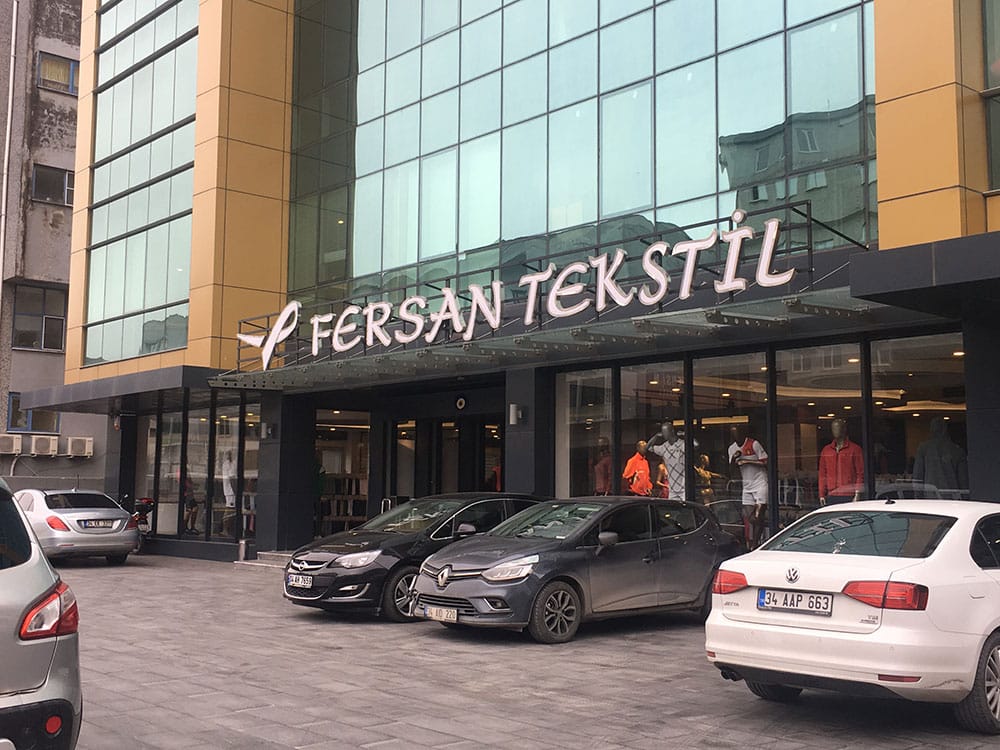
A team of 410 in Beylikdüzü; 50 of them administrative staff. Sales, export, sewing-dispatch and management sit here.
The Beylikdüzü headquarters is where the work is coordinated: sales, foreign trade and export, sewing-dispatch and management all run together. We are 410 in total; 50 of them are administrative staff. The production on the Çorlu floor and the office here run as one team.
We serve Turkey and the wider world from here. From the moment an order arrives to dispatch, records, tracking and accounts run by the book; it is always clear whose hands handled each job. Fersan’s quality and reliability reach the customer through this door.
Our address is Bakırcılar Sanayi Sitesi, Yakuplu / Beylikdüzü, İstanbul. The office, sales and export teams work alongside sewing-dispatch and management under one roof.
| Location | Yakuplu / Beylikdüzü, İstanbul |
|---|---|
| Total staff | 410 people |
| Administrative staff | 50 people |
| Functions | Sales · Export · Sewing-dispatch · Management |
| Address | Bakırcılar Sanayi Sitesi |
Related guides: From Chip to Cloth: The Value Chain and Where the Margin Sits · Where the World’s Polyester Actually Comes From: Producers and the Value Chain
Questions about this unit
Where is the margin in the polyester chain, and where is the risk?
In DIFFERENT places. Traded margin sits largely UPSTREAM: PTA–MEG–chip spreads are oil-linked and swing cyclically — an area a fabric mill cannot control. Lead time and quality risk, by contrast, concentrate DOWNSTREAM, in wet processing and inspection. The practical consequence: a buyer’s negotiating power is highest not upstream where the margin is, but downstream where the risk is.
From the guide: From Chip to Cloth: The Value Chain and Where the Margin Sits
Why does vertical integration make a difference?
Under three headings. Lead time: inter-factory transport, queuing and re-inspection disappear. Traceability: a single lot number ties the greige roll to the dyed batch. And most importantly the right-first-time rate: the lab that approves the lab-dip and the team running the bulk bath are the same, so the drift between the approved shade and the produced shade narrows. All three matter for the same reason — a re-dye roughly DOUBLES a batch’s water, energy, chemicals and machine occupancy.
From the guide: From Chip to Cloth: The Value Chain and Where the Margin Sits
Why is polyester the world’s largest fibre?
Scale and integration. On Textile Exchange figures, polyester is on its own the largest slice of the roughly 132 Mt of global fibre production in 2024: a share of about 57–59% and a volume of around 78 Mt (indicative). That scale comes from an integrated petrochemical chain running from crude oil to paraxylene, on to terephthalic acid and finally to fibre. Recycled polyester forms a separate layer but remains relatively small: about 9.3 Mt in 2024, roughly 12% of the total.
From the guide: Where the World’s Polyester Actually Comes From: Producers and the Value Chain
Where is the supply geography concentrated?
In China. On industry estimates China holds some 75–80% of global polyester filament yarn capacity. Refinery-to-fibre integrated giants such as Hengli, Tongkun, Rongsheng, Reliance and Indorama Ventures control much of that capacity. The practical consequence: when you buy fabric you also, invisibly, become a customer of a global petrochemical-textile chain — the base cost of the yarn is tied to upstream PX/PTA spreads.
From the guide: Where the World’s Polyester Actually Comes From: Producers and the Value Chain
- Address
- Bakırcılar Sanayi Sitesi, Mustafa Kurdoğlu Caddesi No:24, Yakuplu, Beylikdüzü / İstanbul, Türkiye
- Phone
- +90 212 875 43 13
- Opening hours
- Mon–Fri 08:30–18:00 · Sat 08:30–13:00