Factoryone roof

From yarn to dyed roll, under one roof.

In Çorlu, 77,000 m²: knitting, dyehouse, laboratory, quality control and warehouse sit side by side. Walk the sixteen stations where yarn becomes fabric.

77,000 m² under one roof
1,350 tons monthly capacity
250 knitting machines
1982 established

Production line

The whole process, under one roof.

From yarn intake to the dispatch of the dyed roll, every step runs in the same building, on the same record; nothing waits on transport between stages. Five chapters, sixteen stations — all below.

Production Facility

The complete production line, in six and a half minutes.

Walk the sixteen stations below one by one, or watch the plant end to end on film — two speeds of the same line.

Facility

Two sites, one team.

Office and dispatch in Beylikdüzü, 77,000 m² of integrated production in Çorlu — answering to the same people.

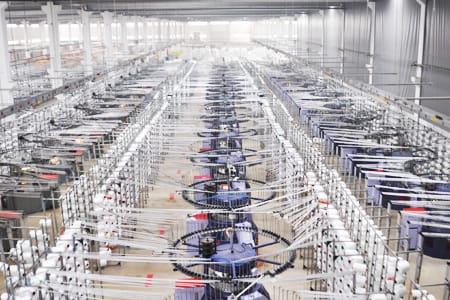
The 77,000 m² single-roof facility in Çorlu: knitting, dyehouse, laboratory and warehouse together.
Facility

Çorlu Factory

Knitting, dyehouse, laboratory and warehouse under one roof: 1,350 tons of fabric a month across 77,000 m².

77,000 m²under one roof

Covered floor
77,000 m²
Monthly output
1,350 tons 100% polyester
Knitting machines
250 machines
Engineering team
1 environmental · 2 textile · 1 mechanical
Station detail
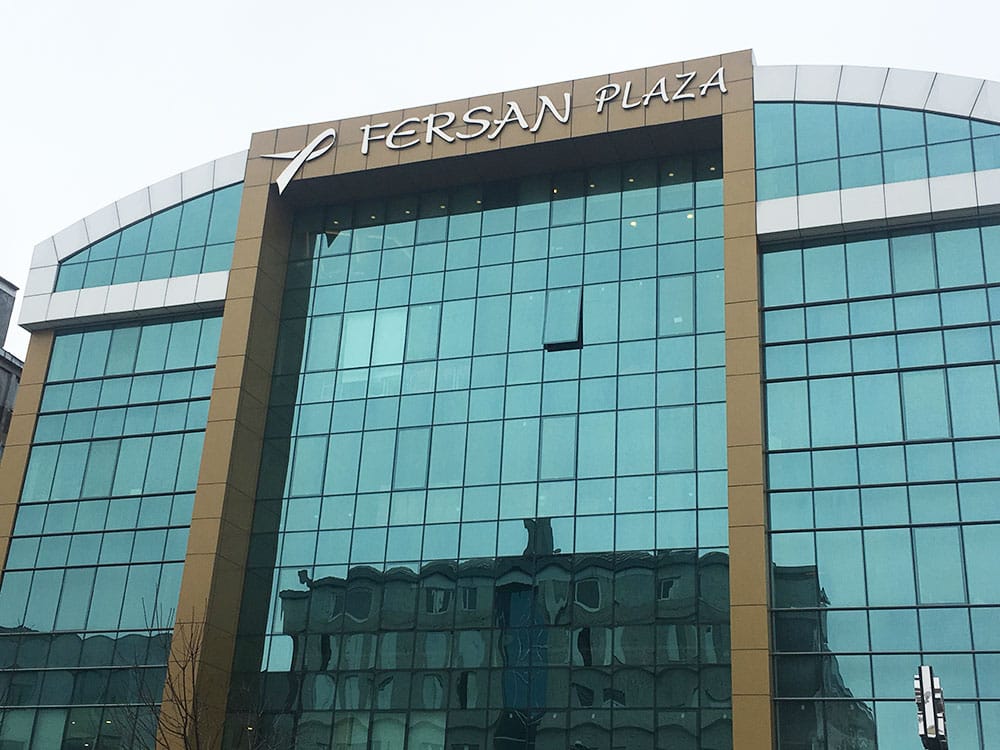
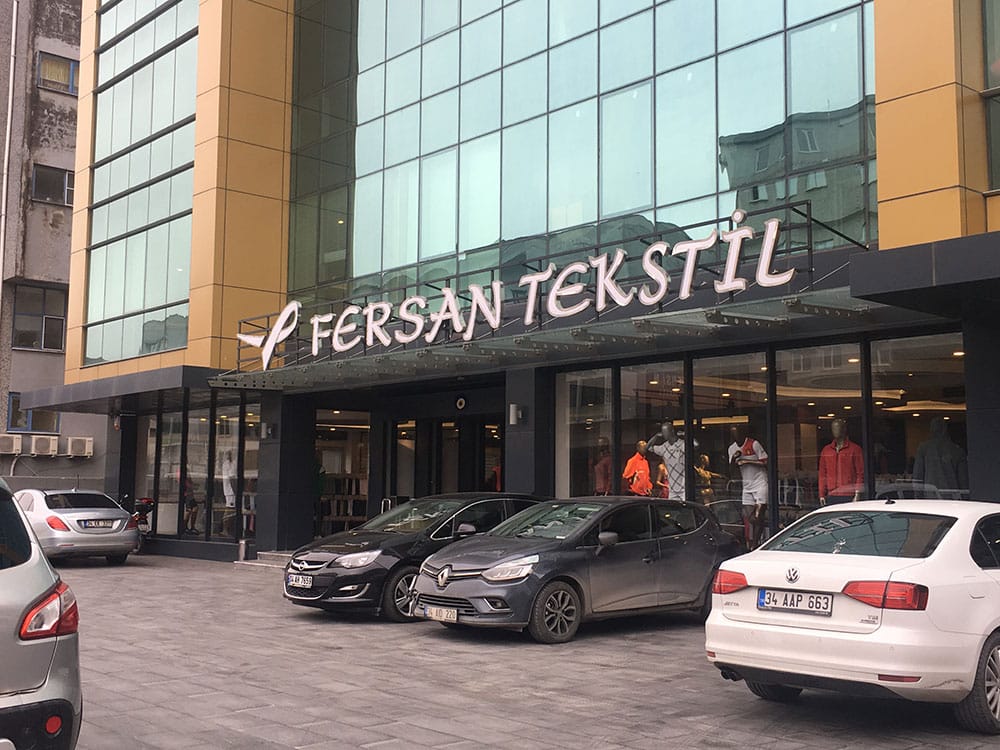
Beylikdüzü headquarters: sales, export, sewing-dispatch and management.
Facility

Beylikdüzü Headquarters

A team of 410 in Beylikdüzü; 50 of them administrative staff. Sales, export, sewing-dispatch and management sit here.

410employees

Location
Yakuplu / Beylikdüzü, İstanbul
Total staff
410 people
Administrative staff
50 people
Functions
Sales · Export · Sewing-dispatch · Management
Station detail
Knitting

Yarn becomes fabric here.

Circular, open-width, jacquard and raschel knitting — all 100% polyester, all under one roof.

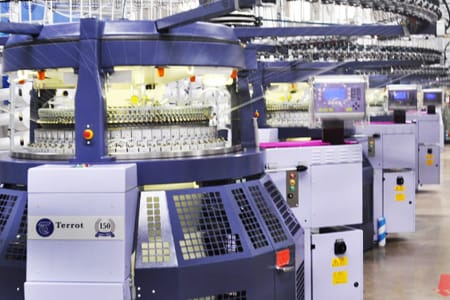
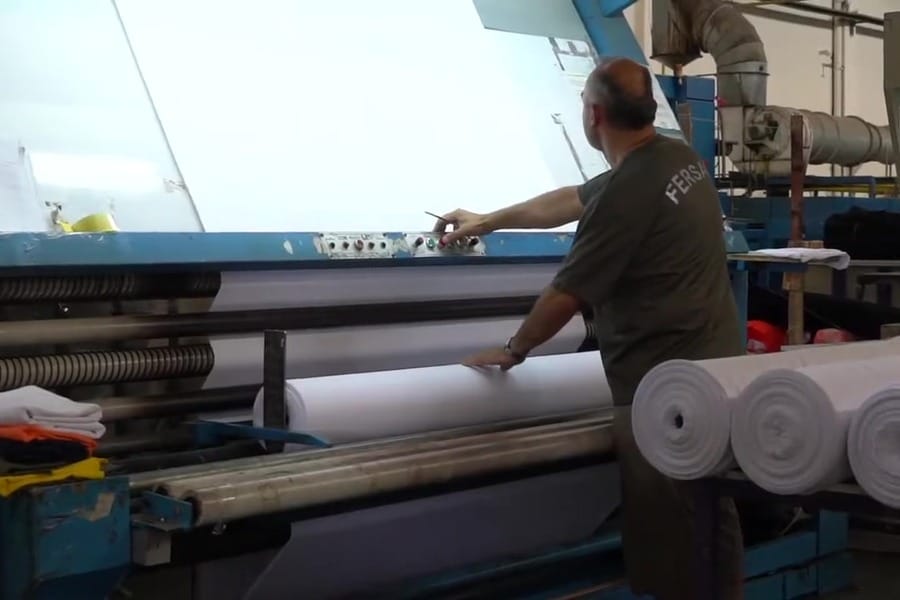
Circular knitting at the Çorlu floor: greige fabric in tube form.
Knitting

Circular Knitting

Knitting in tube form on circular machines; roughly 20–23 kg of greige fabric per roll.

20–23 kgper roll

Knit type
Circular (tube) knitting
Roll weight
Approx. 20–23 kg
Form
Fabric in tube form
Material
Greige fabric (undyed)
Station detail
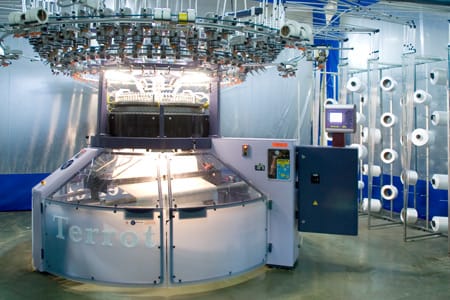
The open-width circular knitting park in Çorlu.
Knitting

Open-Width Circular Knitting

The open-width circular knitting park: the tube is opened, flat full-width fabric comes off.

Method
Open-width circular knitting
Raw material
100% polyester and with elastane
End use
T-shirts and sweat suits
Station detail
Patterned knitting on the electronic and transfer jacquard machine in Çorlu.
Knitting

Jacquard Knitting

Every pattern, set up from the customer’s sample, is knitted on the electronic and transfer jacquard machine.

Jacquardmade to spec

Process
Electronic and transfer jacquard
Pattern
Set up from the customer’s sample
Scope
Any kind of pattern
Source
Customer sample
Station detail
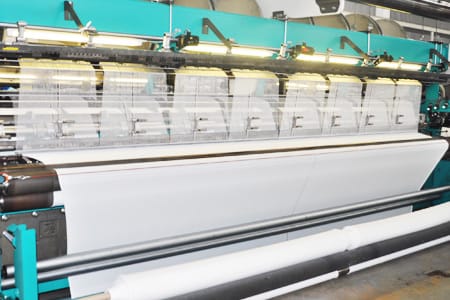
The Raschel park in Çorlu: open-pore warp-knit fabric.
Knitting

Raschel Warp Knitting

The Raschel warp-knitting park: open-pore structures weft knitting cannot reach.

Method
Warp knitting
Raw material
Polyester-based
End use
Raschel fabric · net · Raschel lacoste · air mesh
Station detail
Dyeing & Finishing

Colour verified by measurement.

Dyehouse, stenter and raising: all 1,350 tons produced are dyed and finished here.

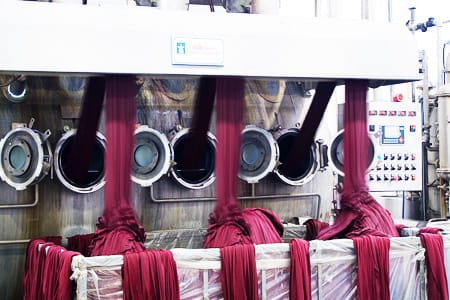
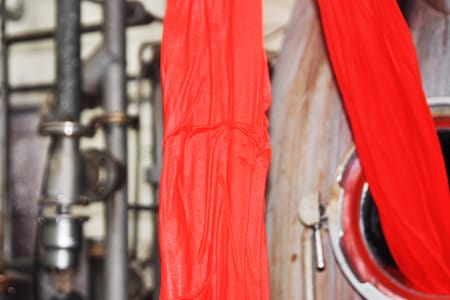
Çorlu dyehouse: kiers from 50 kg to 1 ton.
Dyeing & Finishing

Dyehouse

Six kier sizes from 50 kg to 1 ton, matched to order size; every colour runs to the same standard.

50 kg–1 tonkier sizes

Kier range
50 kg – 1 ton
Kier capacities
50 / 100 / 200 / 500 / 600 kg, 1 ton
Dyeing
Wide colour range, full colour application
Principle
No compromise on standard
Station detail
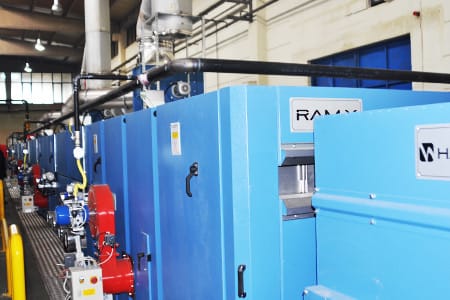
Stenter line at the Çorlu factory: stretch, drying and finishing.
Dyeing & Finishing

Stenter

All 1,350 tons knitted on 250 machines pass through our 7 stenters to be dyed.

7stenters

Stenters
7 professional lines
Output finished
1,350 tons / month
Knitting park
250 machines
Dyeing
To customer quality and colour
Station detail
Raising line in Çorlu: wire drums comb and nap the fabric surface.
Dyeing & Finishing

Raising

No minimum lot for raising; whatever quantity is asked for, the surface is napped and the hand softened.

No minimumlot size

Process
Raising (surface napping)
Lot size
No minimum quantity
Settings
Passes · drum pressure · speed
Control
Hand approved on sample
Station detail
Lab & Quality

No lot ships without a colour match.

Colour matching, an in-house SGS lab and 24/7 quality control — every gram is measured.

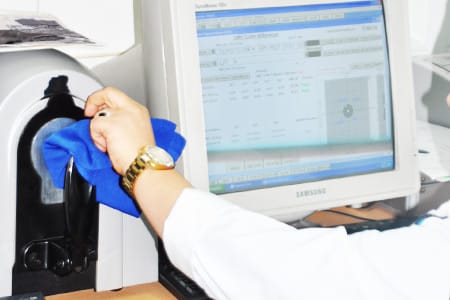
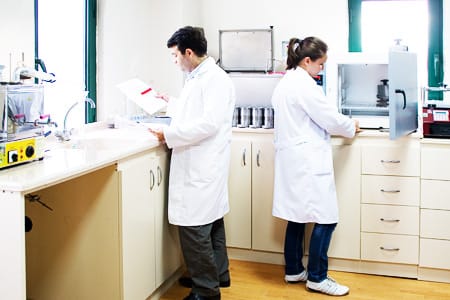
Spectrophotometer colour matching in the Çorlu laboratory.
Lab & Quality

Laboratory

1 expert engineer and 4 chemists; no colour goes to production until the spectrophotometer matches it.

1 + 4expert + chemists

Team
1 expert engineer + 4 chemists
Colour check
Spectrophotometer match
Production gate
No match, no start
Standards
European · SGS · EKOTEKS
Station detail
In-house SGS laboratory at the Çorlu factory, independent control of every phase.
Lab & Quality

SGS Laboratory

An in-house SGS laboratory; trained staff run checks at every stage of production.

every phaseindependent test

Location
On-site (Çorlu)
Facility
SGS laboratory
Scope
Independent check at every production phase
Staff
Trained specialists
Station detail
Quality control unit in Çorlu, working 24/7; sample measurement and reporting.
Lab & Quality

Quality Control

Our in-house control runs 24/7; quality control stays in our own hands, never outsourced.

Quality control rate
90%
Inspection
In-house, our own team
Station detail
Dispatch & Design

The right cloth, on time.

A 10,000 m² warehouse, a 350+ sample showroom and the design desk — one record from choice to dispatch.

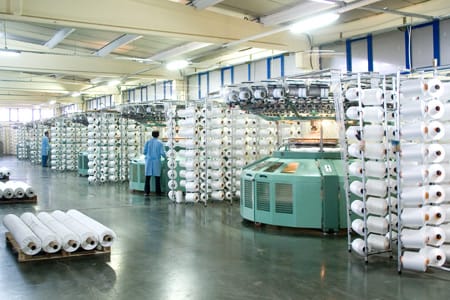
Central greige warehouse — dyed rolls ready for dispatch, Çorlu.
Warehouse & Dispatch

Warehouse & Dispatch

A 10,000 m² central warehouse where all dyed fabric is gathered, then shipped to the delivery date.

10,000 m²warehouse floor

Warehouse floor
10,000 m²
Gathering
Single central warehouse
Dispatch regions
Domestic · Europe · Russia
Planning
To customer dispatch date
Station detail
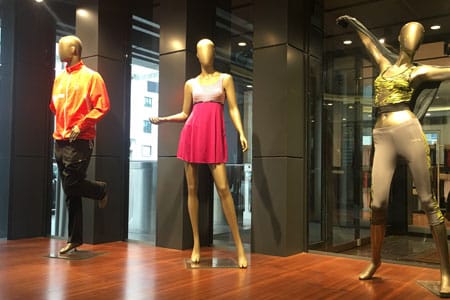
Beylikdüzü showroom: 1000+ product types on open shelves.
Showroom

Showroom

Over 1000 product types on open shelves in the showroom; customers choose by handling the cloth.

1000+product types

Product types
Over 1000
Location
Beylikdüzü
Ordering
Stock samples on selected items, made to order otherwise
Station detail
The design desk in Çorlu: from customer brief to an original pattern.
Design

Design & R&D

We develop new qualities by combining the customer’s requests with our own accents.

3designers

Team
Three graphic analysts and designers
Output
Original, customer-specific pattern
Input
Customer specification and request
Scope
Design & R&D
Station detail

Frequently asked questions.

Production & product

Where is your factory and how large is it?

Our production site is in Çorlu/Tekirdağ, Türkiye, covering 77,000 m² of enclosed area under one roof. Head office and sampling are in Beylikdüzü/İstanbul; the two sites are run by a single team of 410 people.

What is your monthly production capacity?

Our Çorlu mill produces roughly 1,350 tonnes of knitted fabric and 1,800 tonnes of textured yarn per month. Capacity is balanced across the knitting, dyeing and finishing lines, so no single stage becomes the bottleneck.

Which production stages happen inside your own plant?

The whole chain runs in-house: yarn texturising, knitting, dyeing, finishing and roll-up. Because we do not subcontract, colour, weight and lead time stay under one roof — and when something goes wrong there is a single party to answer for it.

How many knitting machines do you have, and of what types?

The park of around 250 machines covers single-bed, double-bed (interlock/rib) and Raschel warp-knitting frames. With a range of gauges and cylinder diameters, the full 60–500 g/m² band can be knitted in house.

Is your dyehouse in-house?

Yes. The dyehouse — HT (high-temperature) jet and airflow machines — sits inside the plant. Owning the dyeing step shortens the path from lab-dip to bulk and lets us control colour consistency between lots directly rather than through a third party.

Do you have a laboratory on site?

Yes. Our in-house lab runs lab-dip colour approval plus weight, dimensional stability, fastness and pilling checks. Independent third-party laboratory reports can also be requested per order.

Can we visit the factory?

Yes. The Çorlu plant can be toured by appointment, with the knitting and dyeing lines seen in production. Send a visit request through the contact form and we will plan the date and any confidentiality terms together.

Which ports and border gates is your factory close to?

Çorlu sits in the Thrace corridor between the İstanbul ports and the Kapıkule border gate. That position shortens road shipments into Europe, while sea and air options run through İstanbul.

How do you plan production?

Once an order is confirmed, the yarn, knitting, dyeing and finishing steps are sequenced on a single plan. Typical lead time is 3–4 weeks from order confirmation to dispatch; the number of colours and the complexity of the finish are what mainly move that figure.

Is fabric shipped tubular or open-width?

Both are possible; which suits you depends on the knit type and your cutting plan. Single-bed structures can ship tubular, while interlock and Raschel usually go open-width. We confirm your preference at the quotation stage.

Technical & quality

Which certifications and audits do you hold?

Ten independent credentials: ISO 9001, ISO 10002, ISO 14001, ISO 45001, ISO 50001, OEKO-TEX STANDARD 100, OEKO-TEX STeP, GRS and RCS for recycled content, plus Higg FEM and FSLM for facility performance.

What is the difference between a facility certificate and a product certificate?

A product certificate (OEKO-TEX STANDARD 100) says the fabric itself meets harmful-substance limits; a facility certificate (STeP, Higg FEM, FSLM) audits the mill that made it — environment, chemistry and working conditions. Buyers usually want both.

How do you inspect fabric?

Roll inspection runs on the four-point system: each defect is scored by its length, and a roll is pulled if the points-per-square-metre threshold is exceeded. The inspection report can be shared with the shipment on request.

How do you keep colour consistent between lots?

Colour is approved by lab-dip, measured in production with a spectrophotometer and tracked as delta-E deviation against the approved standard. On a repeat order of the same shade, the reference stays the approved sample from the first lot.

What do you do about knit defects such as spirality, barré and shrinkage?

Spirality comes from twist liveliness in the yarn, barré from mixed yarn lots and shrinkage from insufficient relaxation. Because we texturise our own yarn, lot mixing is prevented at source; heat-setting and relaxation parameters are tuned separately for each structure.

How do you manage dyehouse wastewater?

No dyehouse effluent is discharged untreated; resource management runs under ISO 14001 and chemical safety under OEKO-TEX STANDARD 100. Water and energy consumption per kilogram is reported within the Higg FEM framework.

Are you open to social compliance audits?

Yes. Worker health and safety is managed under ISO 45001 and working conditions are measured through FSLM. We open the mill to your brand’s own audit protocol or to an independent third-party audit.

Is the fabric traceable back to its raw material?

Because we run the chain from yarn to fabric ourselves, the lot record is unbroken. In recycled production, GRS and RCS chain-of-custody certification verifies that traceability independently — which is the groundwork the Digital Product Passport will require.

What happens if a lot fails to meet the specification?

If the deviation is caught at inspection the roll is pulled and the cause traced to its root: yarn lot, knitting tension, dye recipe or heat-setting. For a dispute after shipment, we review the lot record and test data with you and agree the remedy in writing.

How do you substantiate finish claims?

Antimicrobial, UV-protection (UPF) and water-repellent (DWR) finishes are applied per order and documented with test reports. We do not put a performance label on an unfinished fabric — the claim rests on the report, not the label.

Scale

A year of yarn passes Jupiter.

Take our 1,800-ton monthly polyester yarn capacity as a single 150-denier filament: one gram runs 60 metres, one kilo 60 kilometres. Scroll — let the yarn leave the mill.

  1. Filament1 cm

    150 denier

    It starts finer than a human hair: one polyester filament. A single gram runs 60 unbroken metres.

  2. Package60 km

    1 kg = 60 km

    Unwound, a one-kilo package gives 60 kilometres of continuous yarn — past the Tekirdağ shore from Çorlu.

  3. Marmara110 km

    2 kg ≈ Çorlu → Istanbul

    Two kilos of yarn reach from our roof to the Bosphorus.

  4. Earth40,075 km

    One lap every 16 minutes

    At production pace, the yarn wraps the equator every 16 minutes.

  5. Moon3.55M km/day

    ~4.6 round trips a day

    A day’s output is 3.55 million kilometres of yarn — to the Moon and back, four and a half times over.

  6. Speed41.1 km/s

    At the Sun’s escape threshold

    41.1 kilometres every second. Escaping the Sun’s pull from Earth’s orbit takes 42.1 km/s: the line runs just under the threshold of leaving the Solar System.

  7. One year1.3bn km

    Past Jupiter; Saturn next

    About 1.3 billion kilometres a year: past Mars’ orbit in month 2, the asteroid belt in months 3–4, Jupiter in month 7 — the line ends the year en route to Saturn.

Cosmic yarn ruler: counted as a single 150-denier filament, our 1,800-ton monthly polyester yarn capacity flows 3.55 million kilometres a day — 41.1 kilometres a second, just under the 42.1 kilometres a second needed to escape the Sun’s pull from Earth’s orbit. At that pace the equator is wrapped every 16 minutes, the Moon is reached and returned from about four and a half times a day, and one year covers roughly 1.3 billion kilometres, passing Mars’ orbit, the asteroid belt and Jupiter onto the route to Saturn. The calculation basis and assumptions are printed in the footnote at the end of the section.

Let’s plan your production under one roof.

Whatever the fabric, weight or colour; knitting, dyeing and dispatch answer to the same people. Write to us for a sample or a quote.

Request a sample / quote
  • ISO + OEKO-TEX
  • Within 1 business day we get back to you
Çorlu · Beylikdüzü Established 1982
Request a sample or quote

On this page

Top