
SUSTAINABILITY a sun-powered loop
Measured, documented sustainability.
Solar panels on our roof feed part of production with renewable energy; the water we use, we measure, treat and return to the loop — not by claims, but by documented safety.
Not claims — measured, documented work.
We address sustainability on three foundations: sun-fed production, measured management of water · energy · chemicals, and documented product safety. We name the source of every figure we publish, and give shares and ratios only once independent audit has verified them.
Solar share of production energy.
Solar panels installed on our roof in Çorlu feed part of our production with renewable energy. While knitting and dyeing run during the day, they reduce the energy we draw from the grid — the first concrete step of measured impact.
Our rooftop PV generates roughly 3,000,000 kWh a year — Fersan’s own measurement, independent verification in progress. We will publish its share of total consumption here once that measurement is independently verified.
Our measurement roadmap.
We name the source of every figure we publish, and give shares and ratios only once independent audit has verified them. Below, line by line: what we track, the evidence behind it, and the condition under which we publish the verified number.
| Indicator tracked | Current status & evidence | Condition to publish the verified figure |
|---|---|---|
| Renewable-energy share | Rooftop solar PV is in production at Çorlu: ~3,000,000 kWh a year (Fersan’s own measurement). Its share of consumption is measured under ISO 14001. | Once the first full-year measurement is independently verified |
| Process-water reuse | The wastewater treatment plant is in operation; pre-discharge treatment is certified. | Once an independent water-balance audit is complete |
| Wastewater / ZLD status | Certified to ISO 14001 environmental management; a ZLD (zero-liquid-discharge) roadmap is under assessment. | Once the roadmap is finalized |
| Recycled-yarn (rPET) share | GRS/RCS chain of custody is certified; 610 tons of rPET fabric were produced in the past year (Fersan’s own measurement). rPET content is offered on a per-order basis. | Reported within the GRS audit cycle |
Water — measured, treated, returned to the loop.
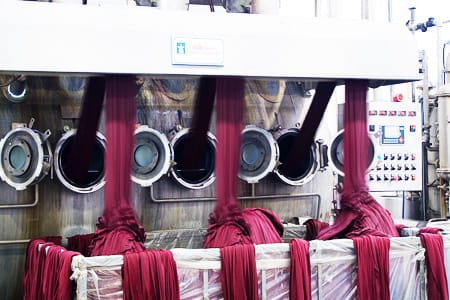
We don’t discharge dyehouse water untreated; we measure what we use, reduce it step by step, and return what’s reclaimed to the loop.
Three guiding principles.
Resource management
Monitoring and gradually reducing water, energy and chemical use in dyeing and finishing.
ISO 14001:2015Safe chemistry
Compliance with harmful-substance limits under OEKO-TEX STANDARD 100 and management of restricted chemicals.
OEKO-TEX® STANDARD 100Durability & recycling
A circular approach with long-lasting polyester and recycled (rPET) yarn options.
GRS 4.0 + RCS 2.0Trust documented by independent audit.
Our sustainability claims rest on certificates issued by independent bodies. The ones below relate directly to environment, safe chemistry and recycling.
Environmental Management System
Proof that environmental impact (water · energy · chemicals · waste) is managed through an audited system.
Harmful-Substance Test — STANDARD 100
Laboratory proof that skin-contact fabric carries no harmful substances.
Sustainable Textile Production — STeP
Facility-level sustainability — six modules, Level 2, ZDHC MRSL 3.1.
Recycled Content — GRS + RCS Scope Certificate
Independent chain-of-custody certificate for recycled polyester (rPET).
As a polyester mill we do not claim cotton/organic standards (GOTS, OCS); our focus is safety and recycling credentials relevant to polyester.
Frequently asked questions.
Company & facility
Do you use solar energy at the factory?
Yes. Solar panels (PV) on the roof of our Çorlu factory feed part of our production with renewable energy and reduce what we draw from the grid during the day. The PV generates roughly 3,000,000 kWh a year (Fersan’s own measurement, independent verification in progress); we will publish its share of consumption once that measurement is verified.
What happens to dyehouse water?
We don’t discharge dyehouse water untreated. We measure what we use, reduce it step by step and return what’s reclaimed to the loop; environmental impact is managed through our ISO 14001 environmental management system.
How much water and energy do you use per kilogram?
Water and energy consumption per kilogram is measured and reported within the Higg FEM framework. We do not publish the figure here as a marketing headline; once your brand opens access on Worldly, you can see our facility data directly.
How is your energy management documented?
Energy is tracked under the ISO 50001 energy management system: consumption data is measured, targeted and opened to independent audit. That certificate means the savings claim is tested by an annual audit rather than asserted.
Is your chemical management aligned with ZDHC?
Dyehouse chemical management runs within the ZDHC MRSL framework and inputs are OEKO-TEX STANDARD 100 certified. Chemistry practice at facility level is additionally tested by the OEKO-TEX STeP audit.
How do you manage production waste?
Waste management starts with measuring cutting and set-up losses, and resource management is tracked under ISO 14001. Vertical integration helps here too: running yarn to fabric under one roof removes the losses caused by intermediate transport and repackaging.
What exactly does Higg FEM measure?
Higg FEM measures a facility’s environmental performance across seven areas: environmental management system, energy and greenhouse gases, water, wastewater, air emissions, waste and chemical management. It starts as a self-assessment; in the verified version an independent auditor confirms it.
Do you calculate a carbon footprint?
Energy and greenhouse-gas data is collected within Higg FEM and tracked under ISO 50001. We do not publish a verified per-product carbon figure; when your brand needs a product-level calculation, we share the data so it can be worked with your own methodology.
How do you reduce the environmental impact of shipping and packaging?
Road freight from Thrace into Europe travels a far shorter distance than sea freight from the Far East, and transport distance is not a negligible line in a fabric’s total impact. In packaging we avoid unnecessary layers and plan roll dimensions around container fill.
How can I verify your sustainability claims?
Every claim has an independent credential behind it: recycled content by GRS/RCS, chemical safety by OEKO-TEX STANDARD 100, facility practice by STeP, environmental management by ISO 14001, energy by ISO 50001 and facility performance by Higg FEM. Copies and verification links are on the certificates page.
Sustainability & certification
Do you supply GRS/RCS-certified recycled (rPET) fabric?
Yes. We hold a GRS 4.0 + RCS 2.0 scope certificate; a Transaction Certificate (TC) is what proves a specific shipment is certified. Tell us the weight and colour of rPET you need and we’ll pull what fits.
How do we choose the recycled content share?
GRS requires at least 20% recycled content, and 50% is the common threshold for a product claim; we set the construction to the brand’s communication goal. Whatever the share, it is documented per shipment with a Transaction Certificate — “contains recycled content” alone is not a verifiable claim.
Is recycled polyester genuinely sustainable?
The honest answer: it needs less virgin petroleum than new polyester and usually less energy, but it is not a solution on its own. Bottle-sourced rPET leaves the bottle-to-bottle loop, and fibre-to-fibre recycling is still limited. The gain is real, and so are its limits.
Is rPET fabric lower in quality than virgin polyester?
Not when it is engineered properly. The concern comes from fibre length shortening during recycling; we limit that from the outset by working with filament rPET yarn. Weight, fastness and pilling are reported against the same thresholds for the rPET and the virgin version.
Does polyester fabric shed microplastics in the wash?
Yes — like all synthetics, it does. Published research indicates recycled polyester can shed more fibre than virgin polyester under some conditions. What reduces shedding sits in structure and finishing: a tighter knit, continuous filament and a clean cut surface. We treat this as a technical constraint to manage together, not a selling point.
What does dope-dyed polyester gain you?
Because the pigment is mixed into the melt, the fabric is not dyed afterwards: the dye bath, its rinse water and the energy of that step all disappear, and fastness rises. The trade-off is colour flexibility — free colour choice becomes harder at small lot sizes.
Do you work with bio-based or alternative polyesters?
Our programme centres on polyester (PET) and recycled rPET. Bio-based polyesters such as PTT and PBT, and chemical recycling technologies, are covered in our Knowledge Centre; if a specific project calls for one, we assess it together with the yarn supply chain.
What is the difference between OEKO-TEX STANDARD 100 and STeP?
STANDARD 100 is product-level; it tests skin-contact fabric against harmful-substance limits. STeP assesses facility-level sustainability across six modules (overall result Level 2, ZDHC MRSL 3.1).
Are you ready for the Digital Product Passport (DPP)?
Because we run the chain from yarn to fabric ourselves, the lot record is unbroken — which is the groundwork the DPP requires. In recycled production, GRS and RCS chain of custody verifies that traceability independently. As the regulation firms up, we shape the data fields to your brand’s system.
Do you hold GOTS or organic-cotton certification?
No. We are a polyester knit mill; cotton/organic standards (GOTS, OCS) are outside our scope. Our focus is safety (OEKO-TEX) and recycling (GRS/RCS) credentials relevant to polyester.
Request a swatch of recycled-content fabric.
If you want OEKO-TEX certified cloth or rPET yarn, tell us the weight and we’ll pull what fits.
- ISO + OEKO-TEX
- Within 1 business day we get back to you