Alongside strictly necessary cookies, we use functional and analytics cookies only with your consent. You can choose your preferences and change them any time. Cookie Policy
Cookie preferences
Manage each category separately. Strictly necessary cookies are required for the site to work and cannot be turned off.
NecessaryAlways on
Required for the site’s core functions, security and remembering your cookie preference — including form security (hCaptcha). No consent required.
Functional
Displays embedded content such as Google Maps. When off, the map does not load until you click “Show map”.
Analytics
Helps us improve the site by measuring visit statistics. Currently inactive; when enabled it runs only with your consent.
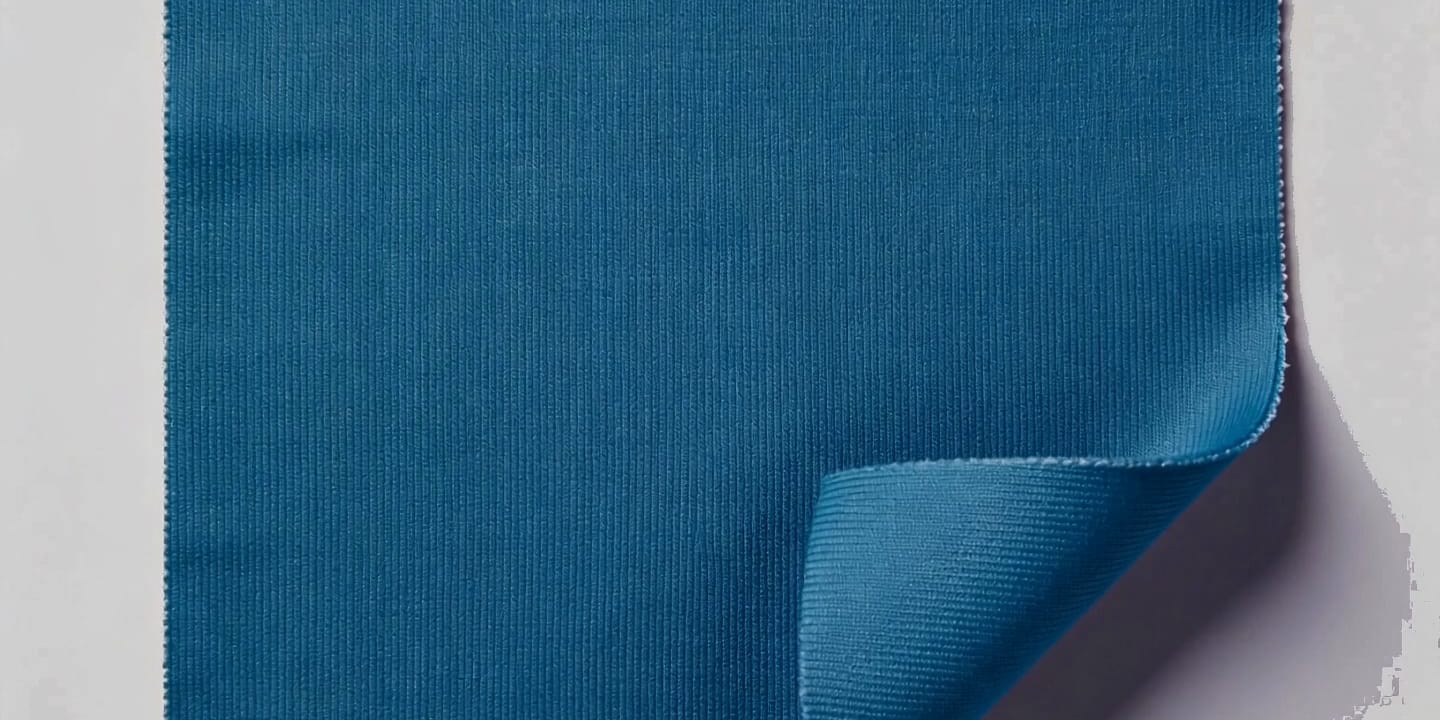
Scuba is an elastane double-face cloth knitted on our double-bed machines and dyed under the same roof. This page sets out the commercial frame of the programme: which weight suits which garment, what the elastane share changes, and how the window from sample to shipment runs. Because one name is applied to three different cloths in this market, we start by fixing the term — a sample of the wrong fabric costs two weeks.
Polyester Scuba
Weight window80–400 g/m²
CertificatesOEKO-TEX® · ISO
IncotermsEXW · FOB · DAP
Scuba is knitted in one piece and has no foam inside it. The bonded fabric-foam-fabric material is neoprene; that is a lamination product and it is not part of our programme. Ponte di Roma is scuba’s closest relative but not the same cloth: ponte carries a faint horizontal rib, is more stable and stretches two ways. Scuba has a flat face, more spring, and stretches four ways. The third confusion is scuba crepe — its face is pebbled and it usually runs lighter; the item in this programme is the smooth-faced one.
Weight decides the garment. The 200–250 g/m² band follows the pattern in leggings, bodysuits and lighter tops; 250–350 g/m² is the working range of structured dresses, skirts and blazers; 350–400 g/m² belongs to outer layers, built jackets and decorative use. We run 500–1,000 kg per colour, which is a markedly lower entry threshold for a brand developing a collection than supply chains that quote by the tonne. Fabric width in our standard window runs ~150–185 cm open-width and ~80–100 cm tubular; the exact figure is settled in the quotation together with cylinder diameter and weight.
Structures neighbouring this programme
01
Polyester Scuba
Scuba double knit
200–400 g/m²
In this application
The core of the programme: flat matte face, four-way stretch, a body that carries the pattern — 200–400 g/m².
Composition
Polyester base + elastane; typically 5–10% elastane (roughly 90–95% polyester). THERE IS NO FOAM CORE: this is a single-piece knitted scuba. The bonded fabric-foam-fabric “neoprene-look” version is a lamination product and is not part of this programme.
Weight windows come from catalogue data; final specs are confirmed on a sample.
Ordering & Sampling
Minimum order (MOQ)
500–1,000 kg per colour — varies by fabric
Lead time
Typically 3–4 weeks from order confirmation to dispatch
Sampling
Sampling terms are set per project and metreage; it begins after a short technical consultation
Response time
Quotation requests answered within 2 business days
Delivery terms
EXW · FOB · DAP — shipping plan confirmed with your quotation
Capacity
~1,350 t/month knitting + dyeing at the Çorlu mill (since 1982)
Roll
Typically 25–35 kg per roll — varies with weight and order
Figures are typical ranges; exact terms are confirmed with your quotation.
Your fabric development partner
Three variables are set together in scuba: the elastane share governs recovery, knit density governs opacity under tension, and heat-setting governs dimensional stability. Colours are approved by lab dip. Where recycled yarn is wanted, the same structure is knitted with GRS-scoped rPET. Opacity is verified on a stretched swatch and recovery after repeated washing.
The link pre-fills the quote form with the fabrics on this page.
Frequently asked questions
What determines the price of scuba fabric?
Price is not one number but the sum of several variables: weight (the metres you get per kilo shift markedly between 200 and 400 g/m²), elastane share, the number of colours and the quantity per colour, the choice of recycled yarn, the surface finish (embossing, sueding, moisture management) and the delivery term. We publish no price list because the cost of the same construction diverges sharply across those items; share these six and a quotation follows within two working days.
Is scuba the same fabric as neoprene?
No. Neoprene has a foam core and its layers are bonded together; scuba is knitted in one piece, has no foam and breathes. The shared name comes from the look, not the construction. Fersan does not laminate — we knit scuba.
What is the minimum order quantity for scuba fabric?
We work in a band of 500–1,000 kg per colour; the exact figure is settled in the quotation according to weight and the number of colours. Sampling and lab dips sit outside that threshold.
Which weight should I choose?
Look at what the garment must do: 200–250 g/m² for pattern-following leggings and bodysuits, 250–350 g/m² for structured dresses and blazers, 350–400 g/m² for outer layers and decorative use. If you are undecided, ask for swatches from two bands — the difference reads instantly in the hand.
Do you produce recycled (rPET) scuba?
Yes. The same structure can be knitted with GRS-scoped rPET yarn, and on request the shipment is documented with a transaction certificate.
Is scuba crepe available in this programme?
The catalogued item is the smooth-faced scuba. Pebbled crepe faces are a separate construction and are assessed per enquiry; tell us the target hand and weight and we will say plainly whether it fits our machinery.