
Jacquard Knitting
Jacquardmade to spec
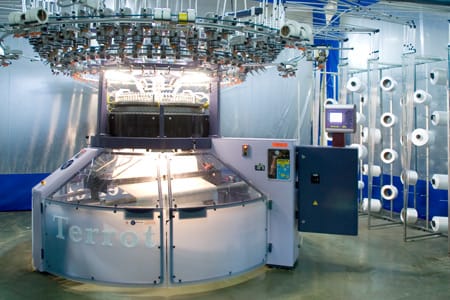
Every pattern, set up from the customer’s sample, is knitted on the electronic and transfer jacquard machine.
Electronic and transfer jacquard is the line that sets a pattern into the machine needle by needle. The customer brings a sample; we read it, set the design up as an electronic or transfer jacquard, and knit the fabric to that setup. Any kind of pattern can be produced here; the limit is the yarn and knit structure that has to carry the pattern, not the machine.
Because the work starts from the customer’s own sample, the pattern belongs to that customer; it does not get mixed with anyone else’s. We build the knit to match the sample exactly and record it so the same pattern can be knitted the same way again and again. That keeps the pattern identical between the first run and the runs that follow.
This line runs under the same roof as our flat knitting and other circular knitting machines; once knitted, the fabric goes into the same dyehouse and finishing process. Since the line itself carries the load of the jacquard pattern, we move on through the later steps without adding any separate treatment to the fabric.
| Process | Electronic and transfer jacquard |
|---|---|
| Pattern | Set up from the customer’s sample |
| Scope | Any kind of pattern |
| Source | Customer sample |
Related guides: The Circular Knitting Machine: Single-Jersey vs Double-Jersey Architecture, OEMs and Production Ranges · The Looms Behind a Roll of Polyester — A Stage-by-Stage Machinery & OEM Reference · Knit Defects: Spirality, Barré and Holes — Root Cause and Control
Fabrics made in this unit
| Jacquard Piqué | 200–370 g/m² |
|---|---|
| Jacquard Mesh | 150–250 g/m² |
Questions about this unit
What is the difference between single-jersey and double-jersey machines?
Single-jersey machines use one needle cylinder; the face and the back of the fabric are visibly different. Single jersey, single-face net and piqué come from this family: they give lightness and stretch in both directions but the EDGE CURLS. A double-jersey machine adds a dial to the cylinder; interlock, rib, 8-lock and 3D spacer are born here: both faces smooth, no curling, twice the thickness and a dimensionally stable ground.
What sets the fabric weight on the machine?
In practice, loop length and yarn count. A common model expresses weight as GSM ≈ K / (Ne × loop length); however a constant such as K ≈ 12,069 is NOT AN ESTABLISHED STANDARD but a published model and should be treated as indicative. Typical ranges: diameter mostly 30–34 inches, gauge E18–E28. Positive yarn feed (Memminger-IRO/BTSR) delivers a constant yarn length to every loop, which is what makes the weight repeatable.
How do you read a TDS like an engineer?
By looking at four axes. First the YARN: the POY/FDY/DTY character, the denier/filament count and the dpf. Second the KNITTING: structure and gauge — because the difference between single and double plate decides the fabric’s fate. Third the WET PROCESS: the dyeing temperature and whether reductive clearing was done. Fourth the FINISHING: stenter heat setting and compacting. A TDS is in truth a summary of these machine decisions.
From the guide: The Looms Behind a Roll of Polyester — A Stage-by-Stage Machinery & OEM Reference
Are the claims in the OEM table verified?
The series names are verified — but POSITIONING STATEMENTS such as “fastest” or “largest”, along with energy-saving figures, are the MACHINE BUILDER’S OWN claims, not independent measurements. The table is not a shopping list but a READING KEY: when you see “interlock, E28, 130 °C disperse, reductively cleared, stenter heat-set” on a TDS, you can map the lines onto the real machines in the chain.
From the guide: The Looms Behind a Roll of Polyester — A Stage-by-Stage Machinery & OEM Reference