
Raschel Warp Knitting
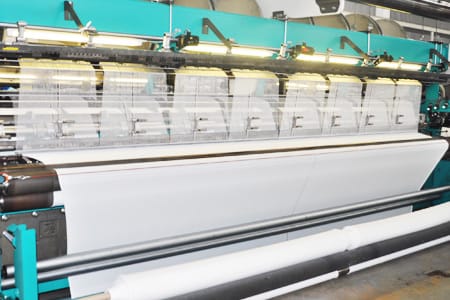
The Raschel warp-knitting park: open-pore structures weft knitting cannot reach.
Raschel knitting is a warp-knitting method: the yarns are looped in the vertical warp direction. This is a different technique from the weft knitting in our circular and flat parks; with Raschel we build structural, open surfaces — tulle, mesh, lace, eyelet and jacquard — that weft knitting could not give us. With elastane added, the family reaches as far as power net with true recovery.
In this park the raw material is polyester-based. In open-pore structures the fabric’s character is set by hole size, knit pattern and yarn fineness; we record those settings for each job and repeat the same structure the same way in the runs that follow. Because of our experience in warp knitting, we are cited as a reference in this area.
The Raschel line runs under the same roof as our circular and flat knitting machines. Once knitted, the fabric goes into the same dyehouse and finishing process without being moved to a separate site; the flow stays unbroken, and each roll’s record carries through to quality control and dispatch.
| Method | Warp knitting |
|---|---|
| Raw material | Polyester-based |
| End use | Raschel fabric · net · Raschel lacoste · air mesh |
Related guides: Beyond Circular Knitting: Warp Knitting and Weaving · Why Polyester Filament Loves the Water-Jet Loom · The Looms Behind a Roll of Polyester — A Stage-by-Stage Machinery & OEM Reference
Fabrics made in this unit
| Athletic Mesh (Raschel) | 160–230 g/m² |
|---|---|
| Tulle / Fine Net | 60–110 g/m² |
| Eyelet Raschel | 180–280 g/m² |
| Raschel Jacquard | 280–500 g/m² |
| Power Net (Elastane Raschel) | 200–320 g/m² |
Questions about this unit
When does warp knitting beat circular knitting?
For linings, shapewear and light mesh, tricot wins: smooth, LADDER-RESISTANT, fine and dimensionally stable. For lace, netting and tulle, raschel is mandatory, because true triangular net and lace demand multi-bar patterning capacity. Warp knitting is the FASTEST fabric formation in textiles: hundreds of needles form loops simultaneously on every revolution; by KARL MAYER’s own data the HKS 2-SE series reaches up to roughly 4,400 rpm.
From the guide: Beyond Circular Knitting: Warp Knitting and Weaving
Why does filament polyester suit the water-jet loom?
Because the hydrophobic filament is NOT WEAKENED by the water droplet carrying the weft, and it dries fast. That makes linings, taffeta, microfibre, umbrella cloth and innerwear fabrics producible very quickly and at low cost. On the water-jet side the Tsudakoma ZW series is the reference leader. All three routes share the same upstream engineering: the yarn’s IV, its lustre and its POY/FDY/DTY character set the final hand whatever geometry it enters.
From the guide: Beyond Circular Knitting: Warp Knitting and Weaving
Why does filament polyester need no sizing?
Because it is a fibre with very low moisture regain: it does not absorb water, is NOT WEAKENED by a water droplet and dries fast. With staple yarn, sizing is essential to prepare the warp for weaving; with filament polyester that step is largely unnecessary. The natural partnership between the water-jet loom and filament polyester arises from exactly this — hydrophobicity turns into a size-free weaving advantage.
From the guide: Why Polyester Filament Loves the Water-Jet Loom
How do you choose between water-jet, air-jet and rapier?
By scenario. The water jet is for hydrophobic filament (polyester, nylon), with weft insertion often exceeding 1,500 m/min — the lowest-cost route for linings, taffeta, microfibre and umbrella cloth. The air jet runs at very high speeds (over 1,000–1,300+ rpm, indicative) and carries staple, filament and technical yarns alike. The rapier carries every type on a mechanical rod or belt — the most flexible and the slowest. Reference OEMs: Tsudakoma ZW on the water-jet side, Toyota JAT and Picanol OmniPlus on air-jet.
From the guide: Why Polyester Filament Loves the Water-Jet Loom