
Showroom
1000+product types
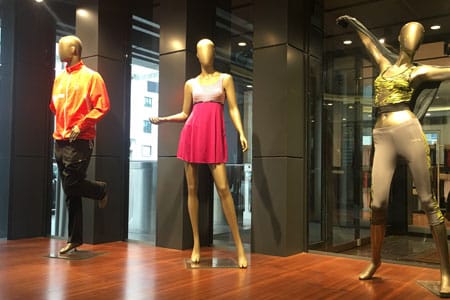
Over 1000 product types on open shelves in the showroom; customers choose by handling the cloth.
The showroom is the selection stop between production and dispatch. Here we keep more than 1000 product types on open shelves; the customer judges weight, hand and drape not on a screen but in the hand.
We arrange the samples by family and by weight, so a fabric’s near-relatives sit side by side and comparison stays quick. A chosen sample moves on the same record as the warehouse and sample teams; the cloth shown and the cloth dispatched are tied to one reference.
The aim is not display but the right choice: the customer knows what they picked by holding it, and we track which sample went to which order in the record.
| Product types | Over 1000 |
|---|---|
| Location | Beylikdüzü |
| Ordering | Stock samples on selected items, made to order otherwise |
Related guides: Polyester Knit Basics: The Backbone of Performance · The Weight Map: Which Knit Goes Where, from 60 to 500 g/m² · The Whole Polyester Chain in One Table: Typical Engineering Ranges
Questions about this unit
Is writing “polyester” enough in a specification?
It is not. The distinguishing measure is denier per filament (dpf = total denier ÷ filament count): the same 150-denier yarn gives about 3.1 dpf at 48 filaments and about 1.0 dpf at 144 — the SAME WEIGHT, two entirely different fabrics. As the filament gets finer, surface area, softness, opacity and capillary moisture spreading all rise; below roughly 1 dpf you are in microfibre territory.
From the guide: Polyester Knit Basics: The Backbone of Performance
What is the difference between filament and staple yarn?
Filament yarn is made of continuous long fibres; its smooth surface, lustre and high tenacity put it in most performance knits. Staple yarn is spun cotton-style from cut short fibres: it reads more matt, softer and closer to cotton in hand, but it is more prone to pilling.
From the guide: Polyester Knit Basics: The Backbone of Performance
Which weight goes to which product?
Roughly: mesh and light jersey 70–150 g/m² (summer, lining); tees and innerwear 120–200; polo/piqué and rib 165–300; sweatshirt/hoodie two- and three-thread 250–350 g/m². The exact band depends on the fabric family.
From the guide: The Weight Map: Which Knit Goes Where, from 60 to 500 g/m²
Does the same weight always give the same hand?
No. At the same GSM, structure, yarn and finish change the hand; for example a 200 g/m² interlock and a piqué of the same weight differ in stiffness, opacity and stretch.
From the guide: The Weight Map: Which Knit Goes Where, from 60 to 500 g/m²