
Eyelet Raschel
| Weight | 180–280 g/m² (5.3–8.3 oz/yd²) In family: 60–500 g/m² · 5 fabrics |
|---|---|
| Composition | 100% polyester (PES); mechanical give. An elastane variant can be knitted when fit and recovery are required. |
| Knit type | Eyelet warp knit · Raschel |
| Use class | Outer / structured |
| Stretch | Mechanical stretch |
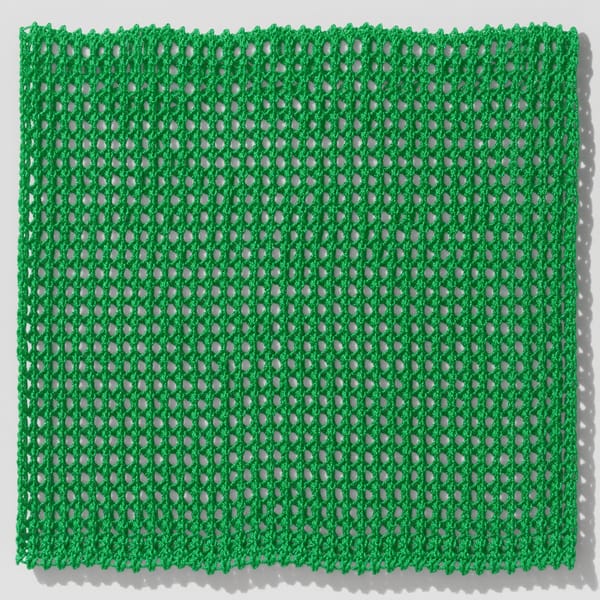
| Knit | A Raschel warp-knit fabric, where yarns are looped in the vertical warp direction; regular eyelet/hole rows deliberately opened into the pattern give a textured, breathable surface. This is technically different from the Mesh & Net family on the site — that family is weft (circular) knit, whereas this structure runs in the warp direction, so the holes are more stable and more resistant to snagging and laddering. |
| Hand | Mid-weight, structured and airy; the holes are felt by hand and the surface is raised; stable in the warp direction, with a bodied rather than loose drape. |
| Typical use | Sport/casual outerwear · breathable lining · structured decorative panel |
| Strength | Combines the stability of warp knitting with an eyelet surface: a breathable yet ladder-resistant, structured mid-weight base. |
| Watch for | Elastane-free pure PES only stretches mechanically, with no true recovery; the open structure lowers opacity and may need a lining. |
Width, gauge, finishing options and test standards are shared on request.
Typical technical ranges
| Weight tolerance | ±5% (typical; the established band for knitted fabrics, warp knits included); on the open structures at the light end of the family (tulle 60–110 g/m²) the same absolute deviation is a larger percentage, so ±5–8% in practice. On elastane power net tension/relaxation state affects GSM — measure on a relaxed specimen |
|---|---|
| Width | OPEN WIDTH ONLY — warp knitting has no tubular form (a structural difference from the weft/circular families). Machine working width typically 130–190 in (≈330–480 cm); after edge trim and stentering, commercial width typically 150–280 cm (260–280 cm at the wide end for tulle and decorative jacquard; 150–190 cm for mesh/eyelet and power net). Final width depends on pattern repeat and draw, confirmed by sample |
| Shrinkage (wash) | Warp knits are DIMENSIONALLY MORE STABLE than weft knits: the warp-locked loops give low relaxation shrinkage. Rigid raschel (tulle · mesh · eyelet · jacquard) typically −1% to −3% length/width after good heat-setting (180–190 °C). Elastane power net moves more: −3% to −5%; with elastane present, heat-set drops to 160–170 °C and excess heat fatigues the elastane and reduces recovery |
| Color fastness | Rigid PES raschel matches disperse-dyed weft knits — wash 4–5; rubbing dry 4–5, wet 3–4; light 4–5; perspiration (acid/alkaline) 4–5. 🔴 POWER NET IS ASSESSED SEPARATELY: disperse dye partitions into the elastane phase and elastane tolerates intensive reduction clearing (RC) less well than PES → wet rub can drop to 2–3 on deep/bright shades. Typical buyer target dry ≥4 / wet ≥3–4; RC quality is decisive. Swimwear use additionally calls for chlorinated-water fastness (ISO 105-E03) |
| Abrasion / pilling | 🔴 MARTINDALE IS NOT MEANINGFUL ON OPEN STRUCTURES — ISO 12947 recognises the “open mesh textile” as its own category; on tulle and mesh, specimen breakdown measures pore geometry rather than surface wear. The governing measures here are BURSTING STRENGTH (ISO 13938-1, hydraulic, 50 cm² area for knits — typically 200–600 kPa on light knits) and SNAG resistance. Pilling is a non-issue on flat-filament warp knits: ISO 12945 typically 4–5 (no staple fuzz). Only the dense power net can be meaningfully Martindale-tested: typically ~20,000–30,000 cycles |
| Gauge / yarn | Raschel machine gauge typically E18–E32, by structure: structural/decorative jacquard and coarse eyelet E18–E24; sport mesh and eyelet E22–E28; fine tulle E28–E32; power net E28–E32 (high-speed raschels that run both elastic and rigid fabric work at these two gauges). Yarn typically 40–150 denier PES filament; 20–50 denier on the finest tulle. Power net binds ~20–70 denier elastane into the PES ground (~18–28% elastane in fabric). In warp knitting yarn is fed FROM THE WARP BEAM, not from cones — beam preparation (warping) is a separate upstream step |
These ranges are industry-TYPICAL / indicative values based on construction and fiber, not Fersan’s binding QC measurements. Exact values are confirmed per order, approved sample and lot-based QC report.
Trade & dispatch
| HS heading | 6006.32 — Other knitted fabric, of synthetic fibres, dyedUnbleached or bleached shipments: 6006.31 |
|---|---|
| Origin | Turkey — Çorlu, Tekirdağ |
| Packaging | Rolls wound on a cardboard core in a PE bag; roll size planned around container fill |
| Shipping documents | Commercial invoice · packing list · A.TR movement certificate · transport document |
| Delivery terms | EXW · FOB · DAP — shipping plan confirmed with your quotation |
The HS heading is indicative; final classification is made by the customs broker based on the sample’s composition, width and finish.
Related reading: Beyond Circular Knitting: Warp Knitting and Weaving · Tricot or Raschel? A Warp-Knit Selection Guide · Warp Knitting’s Hidden Superpower: 3D Spacer Fabric
Related calculators: Warp / beam yarn calculator · Yarn consumption per fabric calculator · Sample weight calculator: from a weighed swatch to g/m² (ISO 3801)
Programmes we use this fabric in: Raschel Warp-Knit Fabric Manufacturer — Turkey · Home Textile Fabrics
Other fabrics in the same family: Athletic Mesh (Raschel) 160–230 · Tulle / Fine Net 60–110 · Raschel Jacquard 280–500 · Power Net (Elastane Raschel) 200–320
Frequently asked questions
What weight range is Eyelet Raschel produced in?
180–280 g/m² (5.3–8.3 oz/yd²). In family: 60–500 g/m². Weight, composition and color options are defined per request; contact us for samples. The weight ranges are Fersan’s production window; exact figures are confirmed by order and approved sample.
What is Eyelet Raschel made of and how is it knitted?
100% polyester (PES); mechanical give. An elastane variant can be knitted when fit and recovery are required. A Raschel warp-knit fabric, where yarns are looped in the vertical warp direction; regular eyelet/hole rows deliberately opened into the pattern give a textured, breathable surface. This is technically different from the Mesh & Net family on the site — that family is weft (circular) knit, whereas this structure runs in the warp direction, so the holes are more stable and more resistant to snagging and laddering.
What is Eyelet Raschel used for?
Sport/casual outerwear · breathable lining · structured decorative panel. Combines the stability of warp knitting with an eyelet surface: a breathable yet ladder-resistant, structured mid-weight base. Elastane-free pure PES only stretches mechanically, with no true recovery; the open structure lowers opacity and may need a lining.
What are the minimum order, lead time and delivery terms?
Minimum order (MOQ): 500–1,000 kg per colour — varies by fabric · Lead time: Typically 3–4 weeks from order confirmation to dispatch · Sampling: Sampling terms are set per project and metreage; it begins after a short technical consultation · Response time: Quotation requests answered within 2 business days · Delivery terms: EXW · FOB · DAP — shipping plan confirmed with your quotation.