
Çorlu Factory
77,000 m²under one roof
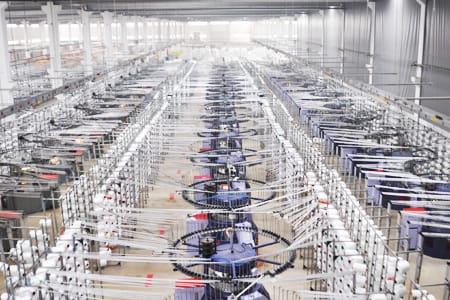
Knitting, dyehouse, laboratory and warehouse under one roof: 1,350 tons of fabric a month across 77,000 m².
Our Çorlu factory is a single-roof facility with 77,000 m² of covered floor. Knitting, the dyehouse, finishing, the laboratory and the warehouse sit side by side under that one roof; fabric leaves the machine as greige, is dyed in the same building, finished and made ready for dispatch. We do not wait on transport between stages; the flow stays unbroken, and so does the record.
With 250 knitting machines we produce 1,350 tons of 100% polyester fabric a month. The floor is run by 1 Environmental Engineer, 2 Textile Engineers and 1 Mechanical Engineer, alongside 200 skilled workers who turn the shifts. The facility is meaningful employment for both the country and the region.
Quality control runs end to end on every product: from yarn intake to the dispatch of the dyed roll, each lot passes through the laboratory and quality control. Fabric made here goes to both the domestic market and export. One roof, one record; we can show what we made and how we made it, step by step.
| Covered floor | 77,000 m² |
|---|---|
| Monthly output | 1,350 tons 100% polyester |
| Knitting machines | 250 machines |
| Engineering team | 1 environmental · 2 textile · 1 mechanical |
| Skilled workers | 200 people |
Related guides: The Looms Behind a Roll of Polyester — A Stage-by-Stage Machinery & OEM Reference · The Water and Energy in One Kilo of Dyed Polyester Knit · From Chip to Cloth: The Value Chain and Where the Margin Sits
Questions about this unit
How do you read a TDS like an engineer?
By looking at four axes. First the YARN: the POY/FDY/DTY character, the denier/filament count and the dpf. Second the KNITTING: structure and gauge — because the difference between single and double plate decides the fabric’s fate. Third the WET PROCESS: the dyeing temperature and whether reductive clearing was done. Fourth the FINISHING: stenter heat setting and compacting. A TDS is in truth a summary of these machine decisions.
From the guide: The Looms Behind a Roll of Polyester — A Stage-by-Stage Machinery & OEM Reference
Are the claims in the OEM table verified?
The series names are verified — but POSITIONING STATEMENTS such as “fastest” or “largest”, along with energy-saving figures, are the MACHINE BUILDER’S OWN claims, not independent measurements. The table is not a shopping list but a READING KEY: when you see “interlock, E28, 130 °C disperse, reductively cleared, stenter heat-set” on a TDS, you can map the lines onto the real machines in the chain.
From the guide: The Looms Behind a Roll of Polyester — A Stage-by-Stage Machinery & OEM Reference
What is the biggest lever in a dyehouse?
The liquor ratio — the weight of water in the bath relative to the weight of fabric. Every litre must be heated, carries chemicals and ends up as wastewater, so lowering the liquor ratio lowers three cost lines AT ONCE. Low-liquor and airflow dyeing take the ratio from around 1:15 down to about 1:4 or below: less water, less mass to heat, less rinsing and less effluent.
From the guide: The Water and Energy in One Kilo of Dyed Polyester Knit
Is “X litres per kilogram” enough as a single badge?
No, it is misleading. The real footprint is the COMBINATION of machine liquor ratio × shade depth × right-first-time rate × the heat and water recovery stages. The environmentally strongest lever is not even a machine but a DISCIPLINE: the right-first-time shade. When a batch that misses the shade is re-dyed, that batch’s water, energy, chemicals and machine occupancy roughly double. Auditing runs through ZDHC, OEKO-TEX STeP and ISO 14001.
From the guide: The Water and Energy in One Kilo of Dyed Polyester Knit
- Address
- Hacışeramet Mevkii, Velimeşe Organize Sanayi Bölgesi, Velimeşe, Çorlu / Tekirdağ, Türkiye
- Phone
- +90 282 674 47 70
- Opening hours
- Mon–Fri 08:30–18:00 · Sat 08:30–13:00