
Laboratory
1 + 4expert + chemists
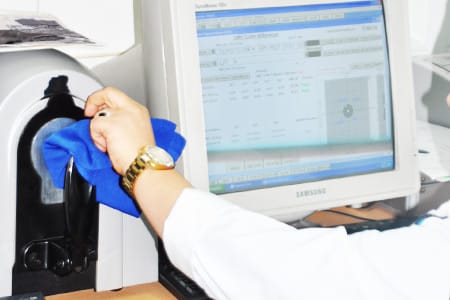
1 expert engineer and 4 chemists; no colour goes to production until the spectrophotometer matches it.
The colour journey starts here. The customer selects and sets the colour; the lab process runs under 1 expert engineer and 4 chemists. We build the requested colour in the laboratory, prepare it in the requested quantity with skilled staff, then hand it to production.
We decide the match by measurement, not by eye. A spectrophotometer checks whether the produced colour matches the customer’s sample; production does not begin until the colours match positively on the spectrophotometer. The call rests on the instrument’s reading, not on a person.
Our production runs to European, SGS and EKOTEKS standards, without harm to people. We keep a record of which colour passed on which recipe and which reading; if a batch does not match, it goes back rather than out.
| Team | 1 expert engineer + 4 chemists |
|---|---|
| Colour check | Spectrophotometer match |
| Production gate | No match, no start |
| Standards | European · SGS · EKOTEKS |
| Starts with | Customer colour selection |
Related guides: Color Management and Delta E in Polyester Knits · How Polyester Is Dyed: Disperse Dyes and HT · Reductive Clearing, Oligomers and Wash Fastness
Questions about this unit
Is a single ΔE number enough to approve a colour?
It is not. No ΔE value means anything until the formula behind it is stated: CMC(2:1) and CIEDE2000 return different numbers for the same pair. The contract must name five layers together — the CIELAB basis, the formula and ratio, the D65 illuminant with the CIE 1964 10° observer, component tolerances (ΔL*/ΔC*/ΔH*) and a metamerism index. Common textile practice keeps the total difference at ΔE ≤ 1.0, and up to 1.5 in some end uses.
From the guide: Color Management and Delta E in Polyester Knits
What is metamerism and why does it affect approval?
Metamerism is when two fabrics match under one light source — daylight, say — yet look different under another, such as store fluorescent; it becomes critical once trims, linings or yarn from a different supplier come together. Its numerical counterpart is the CIE special metamerism index: two samples assumed to match under D65 are compared again under a test illuminant (A, or F11/TL84) and the resulting ΔE is the index. As a rule of thumb, MI below 0.5 is generally acceptable.
From the guide: Color Management and Delta E in Polyester Knits
Can polyester be dyed with reactive dyes?
No. Reactive dyes form covalent bonds with the hydroxyl (-OH) groups in cellulose; the PET molecule HAS NO reactive group to bond to, and because the fibre does not absorb water the dye liquor cannot be carried inside. The only route is to drive water-insoluble disperse dye by diffusion into the amorphous regions of the fibre, where it lodges physically between the polyester chains.
Why is dyeing done at around 130 °C?
Because it is a DIFFUSION problem whose rate is set by chain mobility in the amorphous regions. PET’s glass transition is about 80 °C dry and lower in water through plasticisation. HT/HP exhaust dyeing therefore runs at roughly 130 °C in a pressure vessel: well above Tg, with plenty of free volume. Carrier dyeing does the same job at about 95–100 °C at atmospheric boil by lowering Tg chemically; thermosol does it in dry heat at roughly 180–220 °C in 30–90 seconds.