Alongside strictly necessary cookies, we use functional and analytics cookies only with your consent. You can choose your preferences and change them any time. Cookie Policy
Cookie preferences
Manage each category separately. Strictly necessary cookies are required for the site to work and cannot be turned off.
NecessaryAlways on
Required for the site’s core functions, security and remembering your cookie preference — including form security (hCaptcha). No consent required.
Functional
Displays embedded content such as Google Maps. When off, the map does not load until you click “Show map”.
Analytics
Helps us improve the site by measuring visit statistics. Currently inactive; when enabled it runs only with your consent.
Manufacturing Programme
Polo Shirt Fabric Manufacturer — Turkey
Fersan Tekstil is a vertically integrated polyester knitted fabric manufacturer in Çorlu, Turkey; the polo programme treats body and collar as separate components, because what usually ends a polo is not the body but the collar.
Polo Shirt Fabric
Weight window100–370 g/m²
CertificatesOEKO-TEX® · ISO
IncotermsEXW · FOB · DAP
The life of a polo shirt is not decided by its body fabric. The body will often last for years; what makes a wearer retire the shirt is a collar that has gone wavy, an edge that curls, or a placket that no longer sits flat. A polo is therefore built from at least two components rather than one fabric: the piqué family in the body and the rib family in the collar. They are different knits, they behave differently, and they need to be set differently.
The programme carries that distinction into production. In the body, plain piqué gives the classic stance, elastane piqué gives freedom of movement in a slim fit, mini piqué offers a finer cell and a more closed surface, and jacquard piqué brings a motif knitted into the cloth. In collar and cuffs, rib carries the lateral recovery. When body and collar are dyed in the same bath, the shade-difference problem disappears at source — the most tangible benefit of vertical integration in a polo.
Structures we manufacture for polo bodies and collars
01
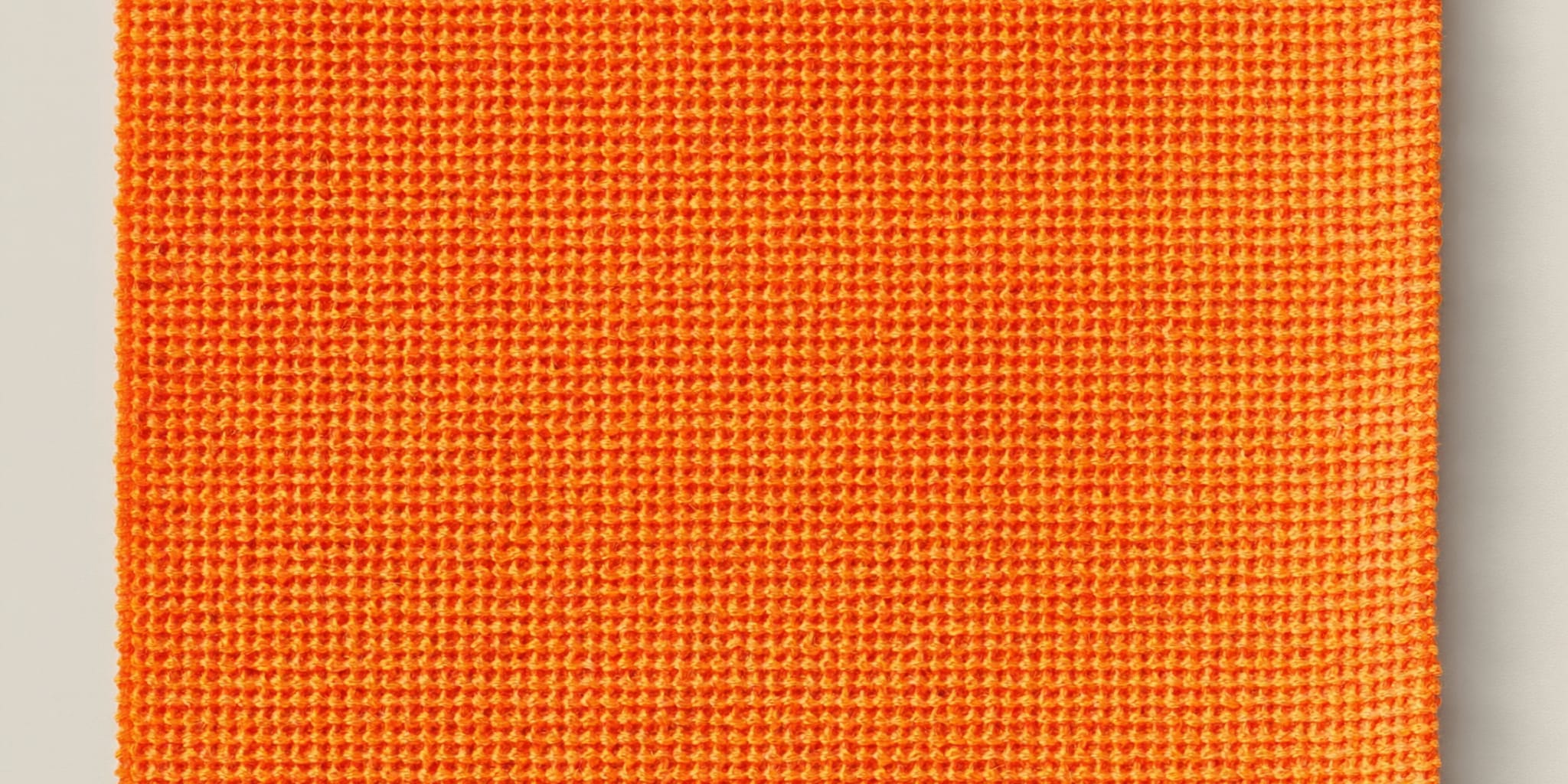
Polyester Piqué
Piqué
150–280 g/m²
In this application
The classic of the polo body: a structured ground with an upright stance — the constant base of corporate programmes.
Composition
100% polyester (typical); microfilament yarn for sublimation lustre.
Weight windows come from catalogue data; final specs are confirmed on a sample.
Ordering & Sampling
Minimum order (MOQ)
500–1,000 kg per colour — varies by fabric
Lead time
Typically 3–4 weeks from order confirmation to dispatch
Sampling
Sampling terms are set per project and metreage; it begins after a short technical consultation
Response time
Quotation requests answered within 2 business days
Delivery terms
EXW · FOB · DAP — shipping plan confirmed with your quotation
Capacity
~1,350 t/month knitting + dyeing at the Çorlu mill (since 1982)
Roll
Typically 25–35 kg per roll — varies with weight and order
Figures are typical ranges; exact terms are confirmed with your quotation.
Colour Matcher — nearest Fersan dye from HEX/RGB (ΔE2000)
Give a HEX or RGB colour and it returns the closest colour from Fersan’s in-house dye library by ΔE2000, plus a closeness score.
Formula
Step 1: sRGB → CIELAB (D65 white point: Xn=0.95047 · Yn=1.0 · Zn=1.08883). Step 2: compute CIEDE2000 (ΔE2000) between the input colour’s Lab value and each library dye’s Lab value; the dye with the smallest ΔE is the nearest match. The colour difference is an estimated on-screen value — a binding match is confirmed by a physical lab-dip. IMPORTANT: Pantone TCX values are proprietary and are not embedded; only Fersan’s curated in-house palette is used.
Worked example
Input #1E5AA8 → RGB(30, 90, 168) → CIELAB(L*=38.58 · a*=10.30 · b*=-47.28). The library is ranked by ΔE2000: the nearest match is “Saraçoğlu Blue” #235FA6 → ΔE≈1.80 — close enough to be indistinguishable to the eye in most conditions.
Input → output examples
Colour (HEX/RGB)
Nearest dye
ΔE2000
#1e5aa8
Saraçoğlu Blue
1.8
#0f766e
İznik Turquoise
16.3
#b45309
Ember Terracotta
7.8
Estimated — indicative value. · On-screen estimate · binding match via lab-dip. No Pantone TCX embedded.
Frequently asked questions
How do I find the equivalent of a HEX colour?
The HEX code is converted to RGB, then to CIELAB under the D65 white point. The ΔE2000 difference is computed against every colour in the Fersan dye library, and the dye with the lowest ΔE is returned as the closest equivalent. The result is a screen-based estimate; it is confirmed by a lab-dip before production.
What is ΔE?
ΔE is a metric that expresses the total difference between two colours as a single number. In CIELAB space the differences on the lightness (L*), red-green (a*) and yellow-blue (b*) axes are combined. The closer to zero, the more identical the colours. This tool uses ΔE2000 (CIEDE2000), which correlates best with human perception.
Which ΔE counts as a “match”?
Common guidance: ΔE ≤ 1.0 is imperceptible to the eye, ΔE 1-2 is very close, and ΔE 2-3.5 is commercially acceptable. The exact limit depends on the colour, end use and customer standard — each brand sets its own tolerance.
Will you give me a Pantone number?
No. Pantone TCX values are proprietary and are not embedded in this tool. Matching is done only against Fersan’s in-house, curated dye library. Share your Pantone reference and we will hit it at the physical lab-dip stage.
Your fabric development partner
We build the polo component by component: the shrinkage behaviour of the body piqué and the collar rib are set relative to one another, because otherwise the collar shrinks differently from the body at the first wash and the stance is lost. On corporate programmes we measure batch-to-batch colour difference and report repeat orders against the same reference.
The link pre-fills the quote form with the fabrics on this page.
Frequently asked questions
Our polo collars go wavy after a few washes — is that the fabric?
Largely yes, but the collar fabric rather than the body fabric. If the collar rib has insufficient lateral recovery, or its heat-setting was set differently from the body, the collar lengthens a little with every wash and begins to ripple. We set the shrinkage behaviour of collar and body relative to one another and report dimensional change separately for each.
Do you guarantee that body and collar match in shade?
Piqué and rib are different knits and can take the same dye to slightly different shades. The remedy is to dye them in the same bath; because knitting and dyeing sit under one roof, we write that into the production plan from the start. Any residual difference is measured in the lab and the acceptance limit is stated in your quotation.
Can you hit the same colour year after year on a corporate programme?
In corporate wear the real difficulty is not the first delivery but the repeat order two years later. We archive the reference colour as a lab dip and measure every repeat against that same reference, reporting the deviation. The colour matcher tool lets you see the closest reference to your brand colour in advance.
Does shrinkage stay consistent across the size run?
On the fabric side shrinkage is constant per square metre; differences between sizes come from the pattern and cutting allowance. We set compacting against your target wash count and report the residual shrinkage rate, so the garment maker can apply that rate to the pattern uniformly across all sizes.
How is a corporate polo order planned?
The 500–1,000 kg per colour band applies separately to body and collar fabric; on corporate programmes a small set of fixed colours usually becomes a year-round running programme, which uses that band efficiently. Typical lead time is 3–4 weeks from order confirmation to dispatch.