Alongside strictly necessary cookies, we use functional and analytics cookies only with your consent. You can choose your preferences and change them any time. Cookie Policy
Cookie preferences
Manage each category separately. Strictly necessary cookies are required for the site to work and cannot be turned off.
NecessaryAlways on
Required for the site’s core functions, security and remembering your cookie preference — including form security (hCaptcha). No consent required.
Functional
Displays embedded content such as Google Maps. When off, the map does not load until you click “Show map”.
Analytics
Helps us improve the site by measuring visit statistics. Currently inactive; when enabled it runs only with your consent.
Fersan Tekstil is a vertically integrated polyester knitted fabric manufacturer in Çorlu, Turkey; in the bird’s-eye programme the texture is built directly by needle action rather than punched afterwards — ~1,350 tonnes a month since 1982.
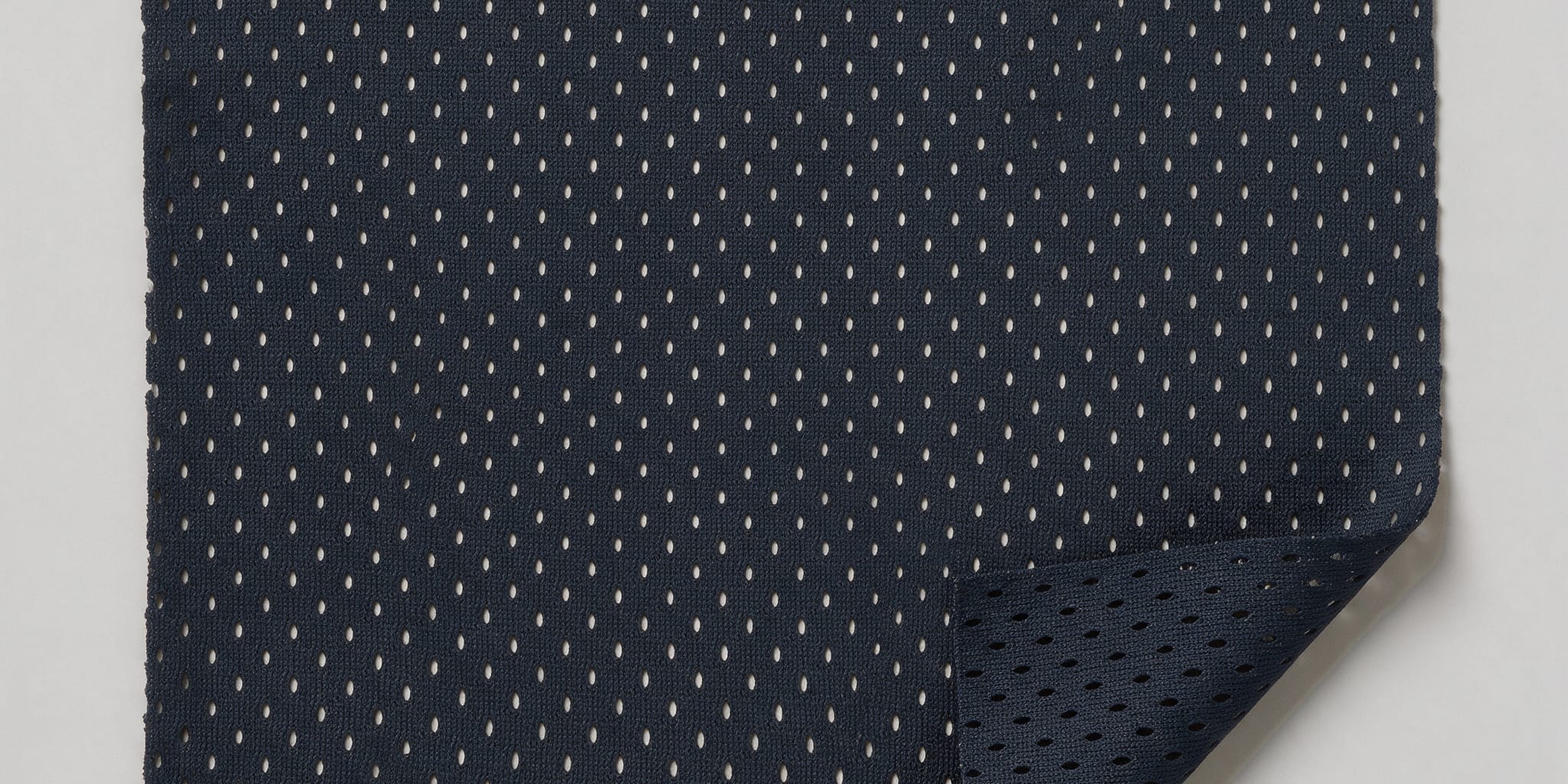
Bird’s-eye Mesh (mock mesh)
Weight window100–370 g/m²
CertificatesOEKO-TEX® · ISO
IncotermsEXW · FOB · DAP
Let us separate the term first, because “bird’s-eye” names three different cloths on the market: a woven pattern in wool suiting, an absorbent weave in cotton household textiles, and a polyester dot-textured knit in sportswear. We manufacture the third. Bird’s-eye mesh comes from alternating knit and tuck stitches: at every tuck point the yarn is held back from the face and leaves a small air pocket behind it. The result is a surface that carries no true holes yet behaves as though it were porous.
In practice this fills the gap between open net and plain jersey: it is not as cool as net, but it does not sit as closed as jersey either, and because coverage is preserved it is a safe ground for prints and logos. Knitted finer, the same movement becomes mini piqué; knitted with a larger cell it becomes classic piqué — which is why this programme is presented together with the piqué family. We supply brands and garment makers across Western Europe, Russia and the CIS.
Our dot-textured (bird’s-eye) structures
01
Bird’s-eye Mesh (mock mesh)
Bird’s-eye mesh (mock mesh)
120–200 g/m²
In this application
The centre of the programme: knit-tuck dot texture, porosity without holes — the benchmark for jersey bodies and performance polos.
Composition
100% polyester (typical); a ~90–92% PES / 8–10% elastane version exists for stretch.
Weight windows come from catalogue data; final specs are confirmed on a sample.
Ordering & Sampling
Minimum order (MOQ)
500–1,000 kg per colour — varies by fabric
Lead time
Typically 3–4 weeks from order confirmation to dispatch
Sampling
Sampling terms are set per project and metreage; it begins after a short technical consultation
Response time
Quotation requests answered within 2 business days
Delivery terms
EXW · FOB · DAP — shipping plan confirmed with your quotation
Capacity
~1,350 t/month knitting + dyeing at the Çorlu mill (since 1982)
Roll
Typically 25–35 kg per roll — varies with weight and order
Figures are typical ranges; exact terms are confirmed with your quotation.
Your fabric development partner
In bird’s-eye development we tune three variables together: cell frequency (dot density), yarn fineness and stitch length. As cells tighten the surface reads more corporate and print definition sharpens; as they open airflow rises and the hand grows crisper. Weight, elastane ratio and finish are engineered to your garment; colours are approved via lab-dip, and air permeability and pilling are documented per order with test reports. Quotation requests are answered within 2 business days.
The link pre-fills the quote form with the fabrics on this page.
Frequently asked questions
What is the difference between bird’s-eye mesh and piqué?
Both belong to the knit-tuck family; the difference lies in cell scale and depth. Bird’s-eye carries smaller, denser, shallower dots; piqué gives a coarser, deeper honeycomb relief. Bird’s-eye prioritises coolness and a flat print ground, while piqué prioritises a structured stand and the classic polo look.
Does bird’s-eye mesh actually have holes?
No. The holes are not opened in the knit; the air pockets left by the tuck points create the porous effect. That is why the cloth does not show through yet still carries air channels — and why it is favoured as a ground for logos and numbers on team jerseys.
Which weights do you work in?
The ranges on each card are our catalogue’s typical window, and every fabric links to its own technical data sheet. If your target weight falls outside the range we assess it together with stitch length and yarn fineness, then confirm it on a sample.
What is the minimum order (MOQ) for bird’s-eye mesh?
MOQ is 500–1,000 kg per colour; the exact figure is confirmed with your quotation. Planning the jersey body and its panel cloth in the same order is an advantage for colour consistency between lots.
What are your lead time and delivery terms?
Typical lead time is 3–4 weeks from order confirmation to dispatch; we work EXW, FOB or DAP. Sampling and lab-dip approval run ahead of that window.