Alongside strictly necessary cookies, we use functional and analytics cookies only with your consent. You can choose your preferences and change them any time. Cookie Policy
Cookie preferences
Manage each category separately. Strictly necessary cookies are required for the site to work and cannot be turned off.
NecessaryAlways on
Required for the site’s core functions, security and remembering your cookie preference — including form security (hCaptcha). No consent required.
Functional
Displays embedded content such as Google Maps. When off, the map does not load until you click “Show map”.
Analytics
Helps us improve the site by measuring visit statistics. Currently inactive; when enabled it runs only with your consent.
Manufacturing Programme
Running Fabric Manufacturer — Turkey
Fersan Tekstil is a vertically integrated polyester knitted fabric manufacturer in Çorlu, Turkey; the running programme gathers the lightest structures we make, where weight is treated as a design constraint.
Running Fabric
Weight window70–200 g/m²
CertificatesOEKO-TEX® · ISO
IncotermsEXW · FOB · DAP
Fabric selection for running follows a different logic from other sports: here weight is traded against distance, not against durability. Every gram on the body is carried for every kilometre; sweat production per unit of surface is at its highest, and the garment gains weight as it wets out. So a running fabric is asked two questions at once: how light does it start, and how much heavier does it get once it holds sweat.
The programme answers both together. Air-permeable mesh forms the thinnest edge of our catalogue for singlets and race tops; microfibre polyester spreads sweat across a wide surface with its fine filament face, accelerating evaporation; polyester jersey and single jersey are the economical base of the everyday training tee; and sports net works as a panel where heat collects, at the back and under the arms. We supply sportswear manufacturers across Western Europe, Russia and the CIS.
Structures we manufacture for running wear
01
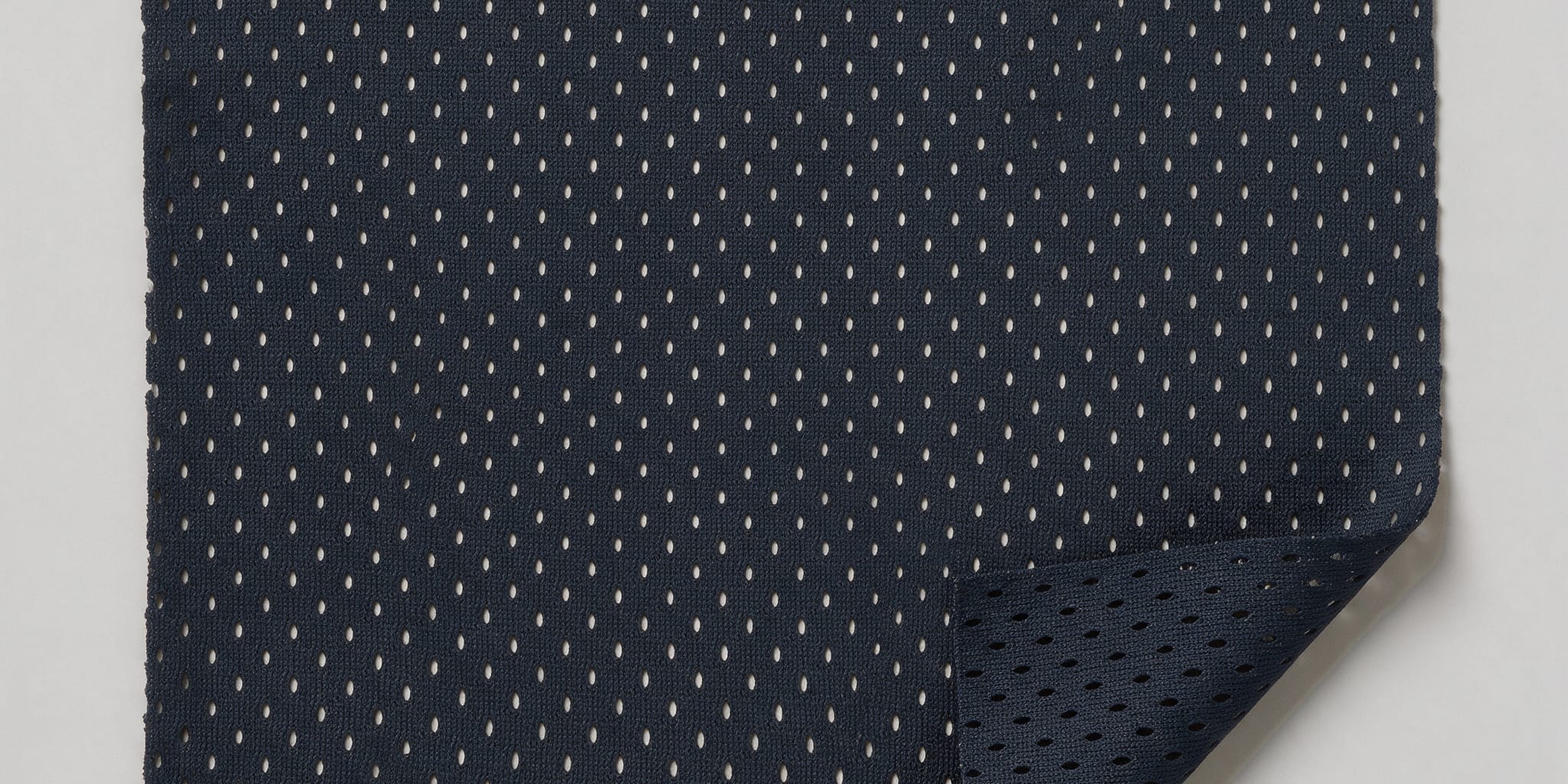
Breathable Micro Mesh (lining)
Breathable micro mesh (lining)
70–130 g/m²
In this application
The thinnest edge of our catalogue: near-negligible weight for singlets and race tops, with an open pore structure.
Composition
100% polyester or, for light stretch, ~90–95% PES / 5–10% elastane; mostly microfilament polyester.
GSM (g/m²) is the weight in grams of one square metre of fabric — the standard measure of fabric weight/density.
What is oz/yd²?
oz/yd² is the weight in ounces of one square yard of fabric — the unit commonly used by US and UK buyers.
Your fabric development partner
We set the target weight with you: construction, filament fineness and finish are built together to reach the hand and opacity you want. The wash durability of the moisture-management finish, rub behaviour at seam areas and dimensional stability are documented with tests per order.
The link pre-fills the quote form with the fabrics on this page.
Frequently asked questions
Which weight should we choose for a running tee?
It depends on distance and climate: the thin edge of the catalogue works for racing and hot weather, the mid band for everyday training and cooler climates. You can compare the weight ranges on the fabric cards, and if you work in oz/yd² the converter below gives you the same figure in your own unit; the final choice is made on a sample either way.
Does the moisture-management finish wash out?
Durability depends on how it is applied. We build the finish recipe around your wash-cycle target and report performance after the agreed number of washes. Polyester fibre itself does not absorb moisture; the finish governs how fast sweat is spread across the surface.
Will the fabric solve chafing over long distances?
Fabric alone will not — chafing is largely a question of seams and pattern. What we can do on the fabric side is deliver a flat, non-fuzzing face and report rub fastness; we recommend planning seamless or flatlock construction on the garment side.
Do you produce reflective and high-visibility colours?
We dye fluorescent and high-visibility shades; reflectivity, however, belongs to a tape or print applied to the fabric rather than to the fabric itself. We match your colour target with a lab dip and report batch-to-batch consistency by measurement.
Can we start with a small collection?
The 500–1,000 kg per colour band varies by fabric; in running collections the most efficient start is to go deep on a few body colours and carry the accent with print. Sampling begins after a short technical consultation, and quotation requests are answered within 2 business days.