Alongside strictly necessary cookies, we use functional and analytics cookies only with your consent. You can choose your preferences and change them any time. Cookie Policy
Cookie preferences
Manage each category separately. Strictly necessary cookies are required for the site to work and cannot be turned off.
NecessaryAlways on
Required for the site’s core functions, security and remembering your cookie preference — including form security (hCaptcha). No consent required.
Functional
Displays embedded content such as Google Maps. When off, the map does not load until you click “Show map”.
Analytics
Helps us improve the site by measuring visit statistics. Currently inactive; when enabled it runs only with your consent.
Manufacturing Programme
Cycling Jersey Fabric Manufacturer — Turkey
Fersan Tekstil is a vertically integrated polyester knitted fabric manufacturer in Çorlu, Turkey; the cycling jersey programme builds the recovery discipline that a garment worn for hours in a single posture demands.
Cycling Jersey Fabric
Weight window85–380 g/m²
CertificatesOEKO-TEX® · ISO
IncotermsEXW · FOB · DAP
A cycling jersey is not judged when it is put on, but in its third hour. As the rider leans forward the back is stretched and the front compresses; once the rear pockets are loaded the fabric carries a constant downward pull. This is why the governing property in a cycling jersey is not stretch but recovery: if the cloth does not return to its original length after being stretched, the pockets sag, the hem rides up, and on the next ride the jersey is no longer the same garment.
The programme distributes that requirement across the layers: elastane interlock holds the body to size, jacquard mesh knits zoned ventilation into the side and back panels, microfibre polyester takes weight out of sleeves and summer jerseys, elastane rib keeps the hem and cuffs in place, and power net carries the load at pocket openings and gripper bands. We supply sportswear manufacturers across Western Europe, Russia and the CIS, and routinely produce to the test standards of European brands.
Structures we manufacture for cycling jerseys
01
Polyester Stretch Interlock with Elastane
Stretch interlock + elastane
120–300 g/m²
In this application
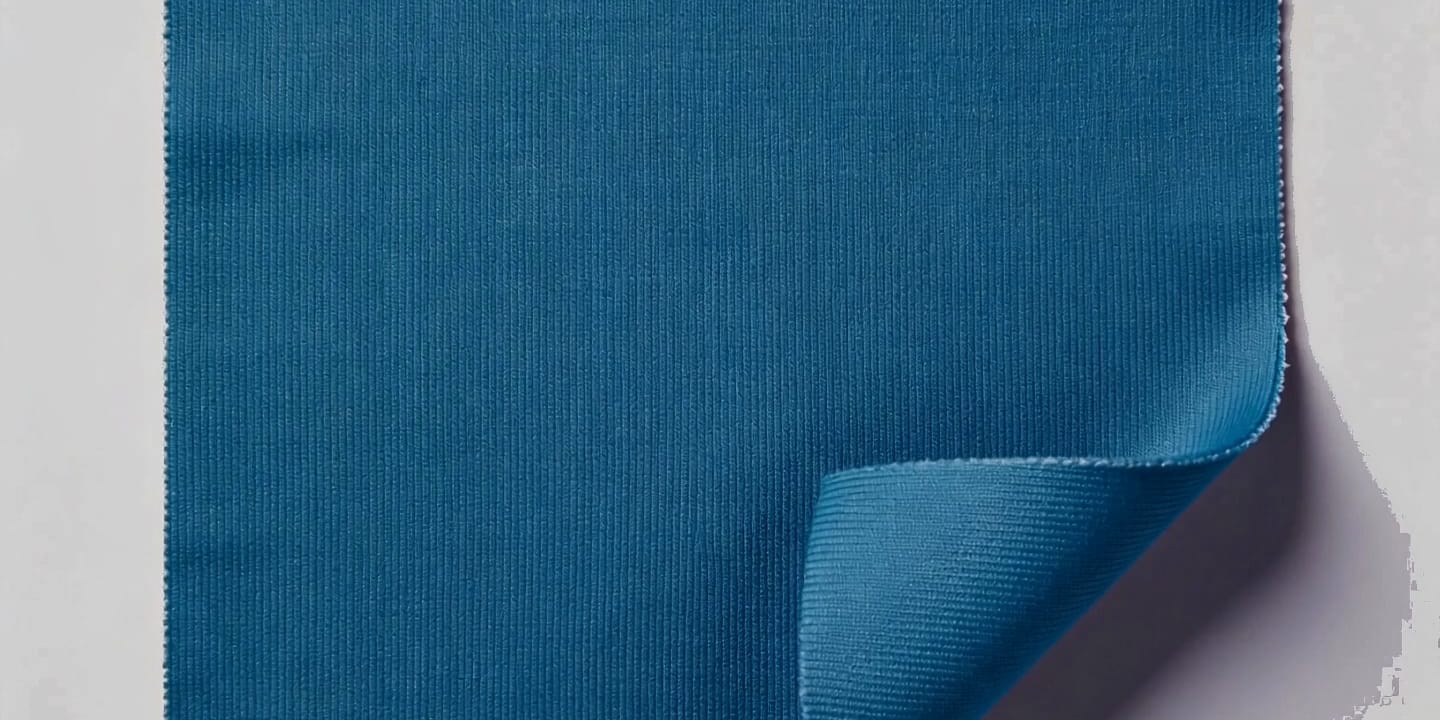
The load-bearing body: a double-face structure that holds its dimensions under rear-pocket load and returns to size after stretch.
Composition
Polyester base + elastane; typically 5–12% (from comfort to high recovery). Higher levels belong to warp-knit power nets, not interlock.
Weight windows come from catalogue data; final specs are confirmed on a sample.
Ordering & Sampling
Minimum order (MOQ)
500–1,000 kg per colour — varies by fabric
Lead time
Typically 3–4 weeks from order confirmation to dispatch
Sampling
Sampling terms are set per project and metreage; it begins after a short technical consultation
Response time
Quotation requests answered within 2 business days
Delivery terms
EXW · FOB · DAP — shipping plan confirmed with your quotation
Capacity
~1,350 t/month knitting + dyeing at the Çorlu mill (since 1982)
Roll
Typically 25–35 kg per roll — varies with weight and order
Figures are typical ranges; exact terms are confirmed with your quotation.
Meter ↔ Kilogram (Roll) Converter
From weight and width, find a roll’s metres ↔ kilograms. Free, no sign-up; the formula used is shown openly on the page.
Formula
Weight per metre (g) = GSM × width(m). Weight (kg) = length(m) × GSM × width(m) ÷ 1000. Length (m) = weight(kg) × 1000 ÷ (GSM × width). Enter either length or weight; the other is computed.
Worked example
180 g/m², 1.5 m width, 1000 m → per metre 180 × 1.5 = 270 g; total 1000 × 270 ÷ 1000 = 270 kg. Conversely 270 kg → 270 × 1000 ÷ 270 = 1000 m.
Input → output examples
Weight (g/m²)
Width (m)
Length (m)
Weight per metre (g/m)
Total weight (kg)
Total length (m)
150
1.6
1000
240
240
1,000
220
1.8
1000
396
396
1,000
320
1.5
500
480
240
500
Frequently asked questions
How many metres is 1 kg of fabric?
Length = 1 × 1000 ÷ (GSM × width). E.g. at 180 g/m² and 1.5 m width: 1000 ÷ 270 = 3.70 m/kg.
How do I find roll weight?
Weight (kg) = length × GSM × width ÷ 1000. Weight per metre = GSM × width (g).
Your fabric development partner
We build the jersey around ride duration: structure choices for body and panels, the sweat-management finish and the elastane ratio are developed to your project; stretch and recovery, perspiration and rub fastness are documented with tests. UPF and antimicrobial finishes are applied on request and evidenced with a test report.
The link pre-fills the quote form with the fabrics on this page.
Frequently asked questions
What is the minimum order for cycling jersey fabrics?
It varies by fabric, but sits in the 500–1,000 kg per colour band. In cycling collections, sharing a team colour across the body, panel and rib fabrics makes that band work efficiently; the exact figure is confirmed with your quotation.
Our rear pockets sag — will this fabric fix it?
Sagging pockets are usually a recovery problem rather than a stretch problem: if the cloth does not return to its original length, the load leaves permanent elongation. A double-face elastane body with power net at the pocket opening changes that behaviour; we measure and report the stretch-and-return ratio per order.
Is it suitable for sublimation printing?
Yes — the polyester base is the native chemistry of sublimation, and in cycling printing is close to universal. Light grounds ship ready for printing; on panelled designs we calibrate the ground shades together so different structures do not diverge in tone after printing.
Do you offer UV protection for long rides?
A UPF finish is applied on request and evidenced with an independent test report; a tight knit and a dark shade already provide baseline protection. Any UPF value to be declared is measured per fabric and colour — we do not claim a blanket figure on this page.
Does the jersey hold its size after washing?
Dimensional stability is set through compacting and heat-setting; perspiration, wash and rub fastness together with dimensional change are reported per order. Production runs with OEKO-TEX STANDARD 100 certified inputs, and the same structures are made on GRS certified rPET on request.