Alongside strictly necessary cookies, we use functional and analytics cookies only with your consent. You can choose your preferences and change them any time. Cookie Policy
Cookie preferences
Manage each category separately. Strictly necessary cookies are required for the site to work and cannot be turned off.
NecessaryAlways on
Required for the site’s core functions, security and remembering your cookie preference — including form security (hCaptcha). No consent required.
Functional
Displays embedded content such as Google Maps. When off, the map does not load until you click “Show map”.
Analytics
Helps us improve the site by measuring visit statistics. Currently inactive; when enabled it runs only with your consent.
Manufacturing Programme
Air Mesh / Spacer (3D) Fabric Manufacturer — Turkey
Fersan Tekstil is a vertically integrated polyester knitted fabric manufacturer in Çorlu, Turkey; in the air mesh programme thickness is built by the geometry of the knit itself rather than by a filling material — ~1,350 tonnes a month since 1982.
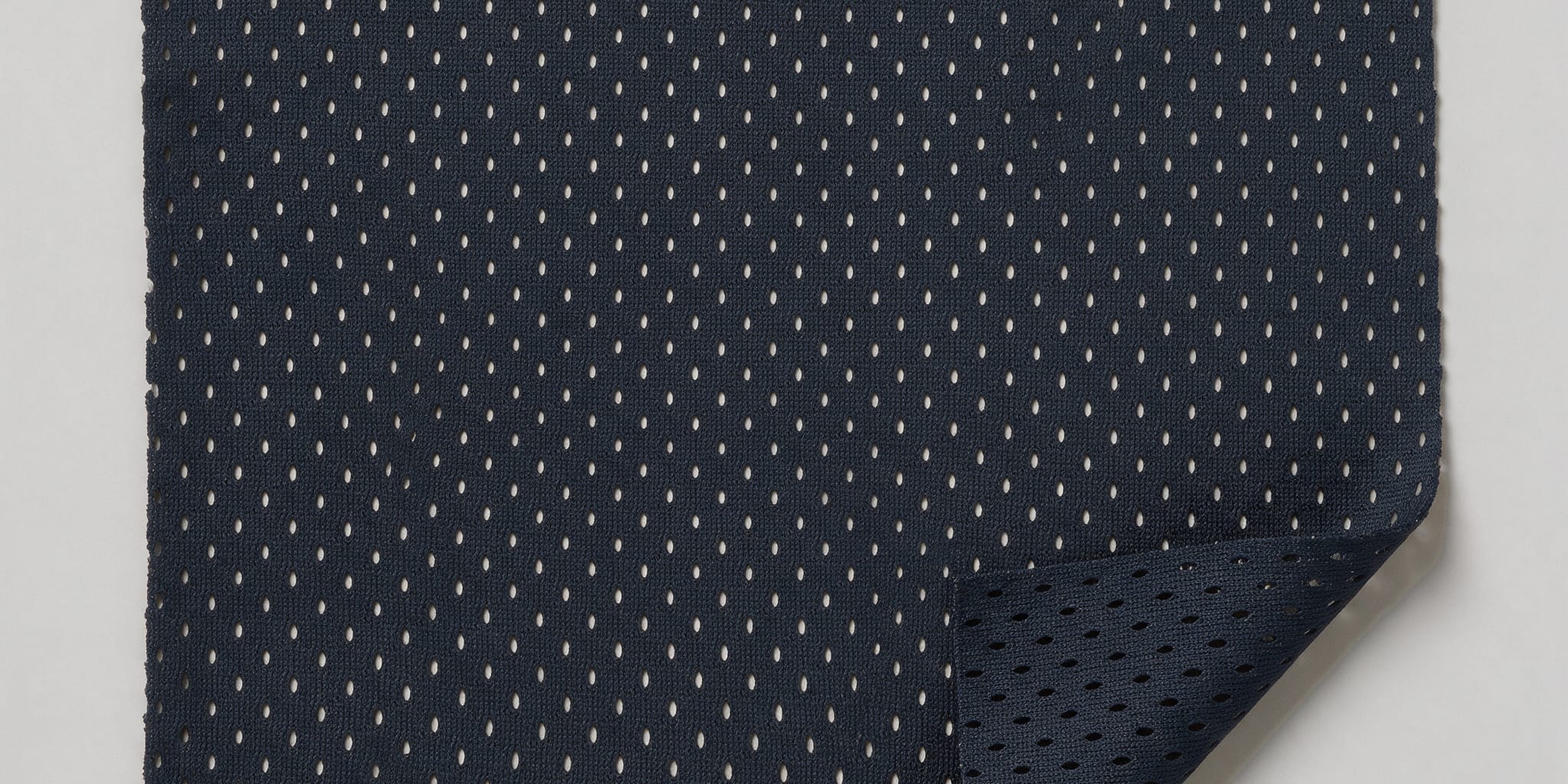
Spacer (3D sandwich) Mesh
Weight window70–250 g/m²
CertificatesOEKO-TEX® · ISO
IncotermsEXW · FOB · DAP
Air mesh should not be confused with single-layer net. Here two separate faces are knitted and upright connecting (pile) yarns are set between them; the cloth therefore carries its own thickness, springs back when compressed and passes air through it without interruption. It does the job foam does, but unlike foam it does not hold moisture: the trapped air returns once pressure is released, and wetness is not kept inside. The industry also calls this structure spacer, 3D spacer or sandwich mesh.
The buyers who choose this geometry are not limited to apparel: backpack bodies and shoulder straps, shoe uppers and tongue linings, seating and automotive trim, orthosis and brace surfaces, sports-bra padding and jacket back panels all draw on the same cloth. Each application asks for a different thickness, compression resistance and surface density — which is why we present air mesh not as a single product name but as an adjustable family of structures.
Our air mesh and ventilation structures
01
Spacer (3D sandwich) Mesh
Spacer (3D sandwich) mesh
180–250 g/m²
In this application
The centre of the programme: the three-layer spacer — foam-free spring, carried thickness and an uninterrupted air channel.
Composition
100% polyester (durable monofilament polyester in the core); some versions use PES/elastane on the faces.
Weight windows come from catalogue data; final specs are confirmed on a sample.
Ordering & Sampling
Minimum order (MOQ)
500–1,000 kg per colour — varies by fabric
Lead time
Typically 3–4 weeks from order confirmation to dispatch
Sampling
Sampling terms are set per project and metreage; it begins after a short technical consultation
Response time
Quotation requests answered within 2 business days
Delivery terms
EXW · FOB · DAP — shipping plan confirmed with your quotation
Capacity
~1,350 t/month knitting + dyeing at the Çorlu mill (since 1982)
Roll
Typically 25–35 kg per roll — varies with weight and order
Figures are typical ranges; exact terms are confirmed with your quotation.
Your fabric development partner
Three variables decide an air mesh development: the distance between the two faces (thickness), the fineness and density of the connecting yarn (compression resistance) and the pore density of the faces (airflow and coverage). We agree upfront whether you want soft cushioning or a load-bearing, firmer surface, and the two faces can be knitted in different patterns and colours. Colours are approved via lab-dip; air permeability and dimensional stability are reported per order. Quotation requests are answered within 2 business days.
The link pre-fills the quote form with the fabrics on this page.
Frequently asked questions
What is the difference between air mesh and ordinary net?
Ordinary net is single-layer and has no thickness; air mesh consists of two faces plus the yarn layer that joins them at right angles. That third layer gives the cloth a measurable thickness, a spring-back response and continuous airflow through its internal volume — net only opens holes, air mesh carries volume.
Can air mesh replace foam?
In most cushioning applications yes, and with two advantages: it holds no moisture and dries quickly after washing. Where very high and sustained pressure demands foam-level compression resistance, we engineer the connecting yarn fineness and density accordingly and confirm the target behaviour together on a sample.
Can the two faces of an air mesh differ?
Yes — this is the structure’s greatest strength. The outer face can be knitted closed and print-ready while the inner face is coarsely pored and skin-friendly, and the two can differ in colour as well. On backpack straps and orthosis surfaces this split is a standard design tool.
What is the minimum order (MOQ) for air mesh?
MOQ is 500–1,000 kg per colour. Because spacer structures are heavy in gram terms, that tonnage corresponds to lower yardage than a fine mesh would; we plan around your yardage target.
What are your lead time and delivery terms?
Typical lead time is 3–4 weeks from order confirmation to dispatch; we work EXW, FOB or DAP. For developments involving thickness and compression behaviour, a sampling round is scheduled ahead of that window.