
Dyehouse
50 kg–1 tonkier sizes
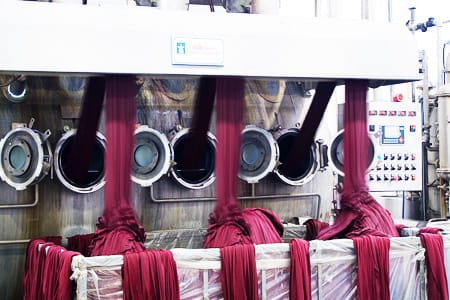
Six kier sizes from 50 kg to 1 ton, matched to order size; every colour runs to the same standard.
Our dyehouse’s technical infrastructure lets us apply every colour the customer asks for. We dye across a wide colour range, in a natural and sound way; whatever the shade, it passes through the same process and the same checks.
We scale the dyeing to the size of the order. Our kiers come in six sizes — 50 kg, 100 kg, 200 kg, 500 kg, 600 kg and 1 ton capacity; a small sample lot and a large production lot are each dyed in their own kier at the right bath ratio.
From kier to kier, only the quantity changes — never the standard. We do not compromise on quality or standards; the same recipe, the same water and the same checks repeat on every lot.
| Kier range | 50 kg – 1 ton |
|---|---|
| Kier capacities | 50 / 100 / 200 / 500 / 600 kg, 1 ton |
| Dyeing | Wide colour range, full colour application |
| Principle | No compromise on standard |
Related guides: Jet, Soft-Flow, Airflow: Understanding the Polyester Dyeing Machine · The Disperse Dyeing Process: HT/HP, Thermosol and Carrier · The Water and Energy in One Kilo of Dyed Polyester Knit
Questions about this unit
Why does the dyeing machine type matter so much?
Because liquor ratio is THE SINGLE BIGGEST lever in dyehouse economics: every litre of water must be heated to about 130 °C, held, cooled, dosed with chemicals and then treated. Typical bands: classic jet/overflow about 1:8–1:12, soft-flow about 1:5–1:8, airflow (aerodynamic) about 1:2–1:4. Airflow carries the fabric on a stream of air or steam rather than a pumped bath, and injects the dye through a separate nozzle.
From the guide: Jet, Soft-Flow, Airflow: Understanding the Polyester Dyeing Machine
What is the process window for dyeing polyester?
Regardless of machine, the typical window is about 110–135 °C (usually around 130), a 30–60 minute hold, pH about 4.5–5.5 on an acetic acid/acetate buffer and roughly 2.5–3 bar. Medium and dark shades need reductive clearing afterwards. A lever as large as liquor ratio is the right-first-time rate: ONE re-dye roughly DOUBLES that batch’s water, energy, chemicals and machine occupancy.
From the guide: Jet, Soft-Flow, Airflow: Understanding the Polyester Dyeing Machine
What do the E / SE / S energy classes of disperse dyes mean?
A classification by molecular size and sublimation behaviour. E (low energy) dyes have small molecules: they diffuse fast and give excellent migration and levelling, but their SUBLIMATION FASTNESS IS WEAK. S (high energy) is the opposite. The class must therefore match the chosen route: goods that go through thermosol or heat setting require the S class, otherwise the dye migrates back to the surface under heat.
From the guide: The Disperse Dyeing Process: HT/HP, Thermosol and Carrier
How do the three dyeing routes differ?
By temperature and mechanism. HT/HP exhaust dyeing runs in a closed machine at about 130 °C and 2–3 bar for 30–60 minutes — today’s standard path. Carrier dyeing does the same job at atmospheric 95–100 °C in 60–90 minutes by lowering Tg chemically; it is chosen where there is no pressure equipment or with heat-sensitive blends such as elastane. Thermosol is the continuous pad-dry-bake route: roughly 190–220 °C for 30–90 seconds. After all three, reductive clearing is the insurance policy on fastness.
From the guide: The Disperse Dyeing Process: HT/HP, Thermosol and Carrier