
Stenter
7stenters
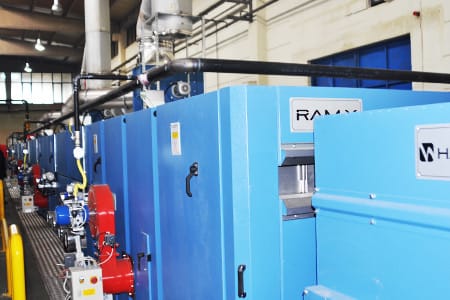
All 1,350 tons knitted on 250 machines pass through our 7 stenters to be dyed.
In the dyehouse every batch is dyed to the quality and colour the customer asks for; the stenter is the final step that holds the fabric to width, weight and handle as it comes off the wet process. The full 1,350 tons knitted on 250 machines at the factory pass through this line; no roll goes to the warehouse undyed or unfinished.
The line runs 7 professional stenters. That capacity lets us take dyed fabric on without it waiting, which speeds the process up; batches do not pile into a queue, and the goods are ready for dispatch quickly. Colour and weight stay the same from roll to roll, because we set the line to the sample and keep it the same batch to batch.
This is where the reliability sits: we run stretch, temperature and speed by recorded settings; if a batch is off-colour it goes back, it does not ship. If the customer’s line is running, the fabric is on the loading bay on its day.
| Stenters | 7 professional lines |
|---|---|
| Output finished | 1,350 tons / month |
| Knitting park | 250 machines |
| Dyeing | To customer quality and colour |
| Function | Sets width, weight and handle |
Related guides: What a Stenter Really Does: A Heat-Setting Guide · Durable Water Repellency (DWR): PFAS-Free Chemistry and Durability · Compacting & Residual Shrinkage: How Compactors Lock In Dimensional Stability
Questions about this unit
What exactly does a stenter do?
It does four jobs in ONE PASS. Thermal setting: the fabric passes through hot-air zones at typically 180–210 °C for some 20–60 seconds, the amorphous regions reorganise and polyester is given a new thermo-mechanical MEMORY. Width control: pin or clip chains stretch the fabric to a programmed width. Overfeed: feeding the fabric faster than the exit speed adjusts length and weight. Chemical pad: the padder at the entry runs the fabric through a finish bath to roughly 40–70% wet pick-up, and the finish is cured in the same pass.
From the guide: What a Stenter Really Does: A Heat-Setting Guide
Should you pre-set or post-set?
They serve different purposes. Pre-setting fixes the greige knit BEFORE dyeing: the fabric settles into a flat, tension-free and crease-free geometry, so the subsequent 130 °C disperse bath carries less risk of crease marks and barré. Post-setting comes AFTER dyeing and reductive clearing and locks the final width, hand and finish. The canonical order is dyeing → drying/relax → heat setting (+pad) → surface finishing → compacting → inspection.
From the guide: What a Stenter Really Does: A Heat-Setting Guide
Can a PFAS-free DWR repel oil too?
Usually not — and that is where the limit lies. Water has a surface tension of about 72 mN/m, so pushing a surface’s critical surface tension below that is enough to repel water. But common OILS sit at only 18–33 mN/m; to repel oil as well, the surface must drop below that figure too — and that remains largely FLUORINE’S TERRITORY. PFAS-free chemistries (dendrimer, silicone/PDMS) beat water handily, but any oil-repellency claim should be read carefully.
From the guide: Durable Water Repellency (DWR): PFAS-Free Chemistry and Durability
How is DWR performance measured?
The basic method is the spray test: AATCC TM22 / ISO 4920. Fabric is clamped in a 150 mm hoop at 45°, about 250 mL of distilled water is poured through a standard nozzle, and the wetting pattern is graded on a scale. The real question is not the first grade but DURABILITY: repeating the same test AFTER WASHING. DWR is applied by padding, squeezed, dried and cured on the stenter — depending on the resin, curing typically sits in the 150–170 °C band. The transition is no longer only ethical but a timetable: in the EU the PFHxA restriction is entering force in stages.
From the guide: Durable Water Repellency (DWR): PFAS-Free Chemistry and Durability